

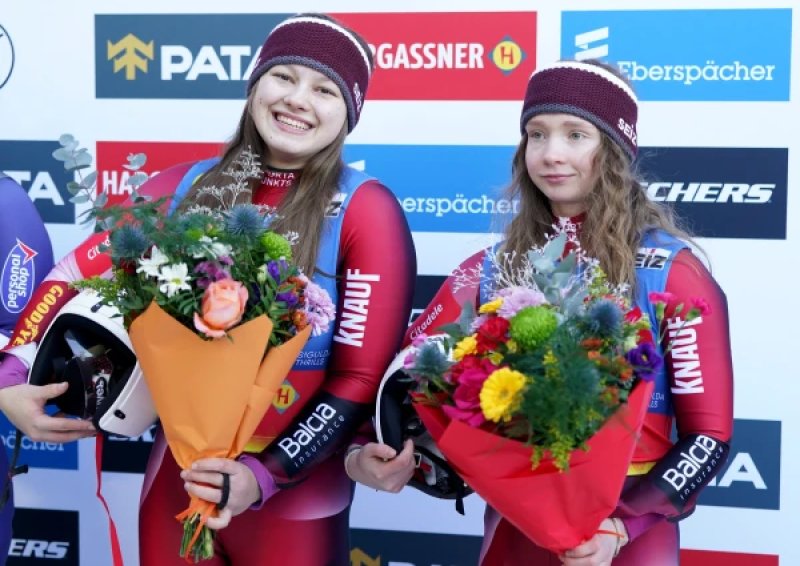
According to Bogdanova, the duo of Robežniece / Bogdanova made significant progress over the summer. "We want to prove that we can consistently navigate the tracks. Last year, it often happened that one run was very good, while the second was average or even weak. We want both runs to be successful so that we can be satisfied with our results. This is our goal for the season," says Bogdanova. > "This year we are adapting faster, understanding and correcting mistakes more quickly, and the runs themselves are becoming more similar to each other," she adds. "We want stability in every start. We are not thinking about medals. Medals will come when we work hard enough and push ourselves," agrees Robežniece. She notes that a lot of work has been done to achieve stability, including on a psychological level. Special attention was paid to ensuring that both runs were equally good, as well as to the reaction at the start. > "I personally work on both the quality of sleep and the details that help maintain stability and psychological resilience. I feel good," says Robežniece. She emphasizes that the duo has also made significant progress in physical training — this is reflected in both the starting sprints and the achievement of standards, as well as in gym training, where the athletes are working with increasingly heavier weights. Robežniece highlights coach Daniel Vogel, who pays attention to the psychological comfort of the duo, as well as psychologist Gundega Ulme from the Latvian Olympic team (LOT), who initially worked with the athletes at the Murjani Sports Gymnasium (MSG). Robežniece emphasizes the benefits of the psychologist's advice, discussions about sleep quality, breathing, and relaxation exercises. Of the tracks where they will compete this season, the duo has not yet raced on three. "We have not raced on the tracks in the USA — in Park City and Lake Placid — and on the track in St. Moritz in Switzerland, where competitions will take place after the Olympic Games," says Robežniece, adding that last season there were also three tracks where the duo had not yet competed. > "We will have about nine runs to understand how to navigate these tracks. This will be challenging for both us and the coaches — physically and psychologically, as the change in time zones, habits, diet, and culture has a significant impact. I am preparing for this together with my psychologist," emphasizes Robežniece. "We need to understand the character of the new tracks and the key sections as quickly as possible." "We are particularly concerned about the tracks in the USA because, for example, Anda Upīte said that both tracks in the USA are challenging and different from the European ones," emphasizes Bogdanova. The athletes do not think about whether they are the best duo in the Latvian national team. According to Bogdanova, there is a friendly atmosphere among the women's duos in the team, and the athletes try to support each other and do not pay attention to which duo is currently stronger. "We rejoice in their successes, they rejoice in ours, and we support each other on the track when needed," says Bogdanova. "The fact that we are considered the first duo is probably related to the fact that Upīte has a new partner — Madara Pavlova, and they have not yet competed in any events, making their results difficult to predict." At the end of October and the beginning of November, the Latvian national team held training camps on the track of the 2026 Olympic Games in Cortina d'Ampezzo. > "We really liked the track in Cortina. We made our first run from the junior start, and it felt fun, like on a carousel. When we started from the women's start, it became a bit more challenging, but it is a pleasant track," says Bogdanova. "This track does not feel very fast, but the results show that the speed is good." "In terms of the work put in, the track in Cortina is something between Innsbruck and Oberhof. You need to work, but in clearly defined places," adds Robežniece. "After the run, I am a bit out of breath — that means the work has been done. The track is challenging, but you can feel both the track and the speed. After the run, there are very pleasant feelings," she says, adding that what worries her the most is how the profile of the track, its preparation, and the weather conditions affecting the ice will change the next time the Latvian lugers find themselves in Cortina. This season, nine stages of the World Cup (WC) are planned. The WC season will start in early December on the track in Igls (Austria), followed by two stages in the USA — in Park City and Lake Placid, and a stage in Sigulda will take place just before the New Year. After the fifth stage in early January, the Olympic qualification will end, and medals for the European Championship will be contested at the first of two stages on another German track — in Oberhof. In early February, athletes will compete at the Olympic Games in Milan — Cortina d'Ampezzo.