

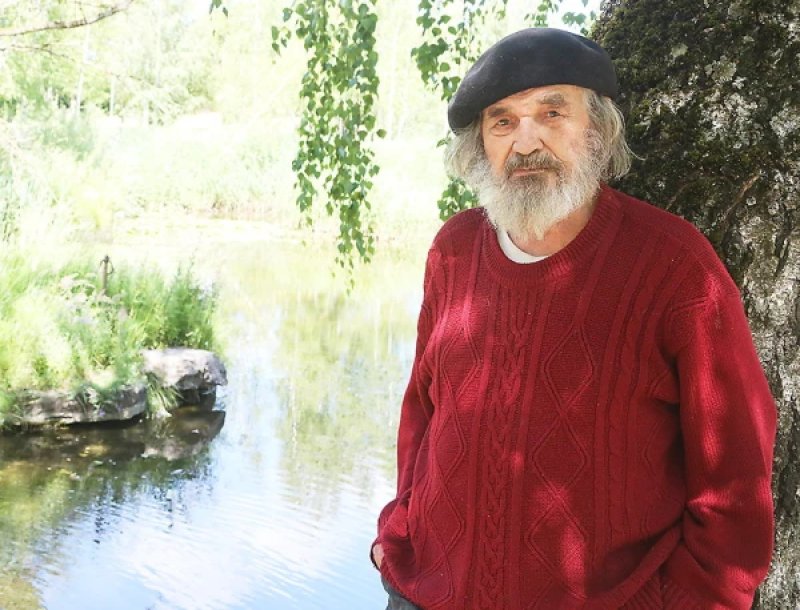
## And this is all about him Even a brief account of Kudojar's life is impressive. Born in Ukraine, he arrived in Latvia in 1945. He painted the Spilve airport, adding a fifth star to the hero on the ladder of a fire truck for General Secretary Brezhnev on what was then Lenin Street (now Brivibas). He is credited with numerous paintings. And after him, there remains a park in the Riga district of Darzini, which he began to develop himself in 1972 on the site of a former dump. One of his friends helped with a bulldozer that excavated 1,200 cubic meters of contaminated soil and leveled the landscape. Another friend helped find dump trucks to remove the waste. The park was established in the early 1980s, and in 2016, the Riga City Council officially approved the park's status and named it after its creator. 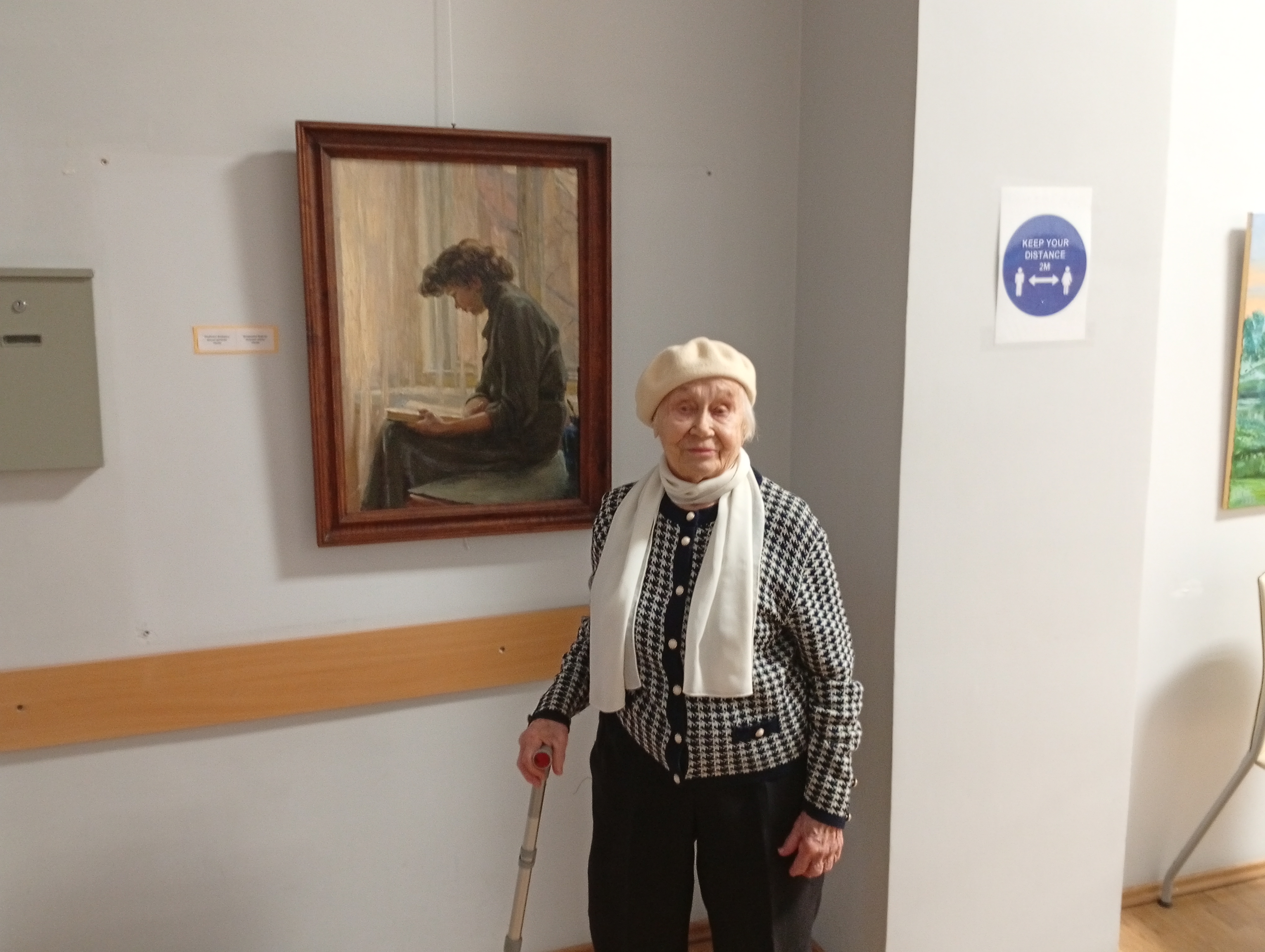 _The widow of the artist, Valentina Kudojar, and a portrait of her at 24 years old. Photo: Andrey Shavrey._ ## A hereditary gardener Vladimir Nikiforovich himself believed that of all the arts, the highest is garden and park art, as the first gardener was God, who created Eden. Moreover, it is hereditary - Kudojar's father was a gardener. For landscaping, Vladimir bought and planted 120 trees: fluffy spruces, maples, birches, and willows. Several hundred shrubs and perennial flowers for the flowerbeds were purchased at the Botanical Garden. When the Riga Hydroelectric Power Station was commissioned and the groundwater level rose, it became possible to arrange the park with six ponds. The opening of the current exhibition in memory of the artist took place under mystical circumstances - during a brief repair in the exhibition hall, the lights were turned off for an hour. The exhibition was opened by candlelight, with speeches being made. ## An artist with a capital letter "But he is indeed a unique artist," said BIArt curator Valentin Danilenko. "And here are his friends participating, among them Nikolai Krivoshein, Valery Makovoy, Evgenia Sundejeva, and Nadezhda Kolesnikova, who responded as one of the first. I noticed from the works that the artists brought, and his circle of communication amazes me. Abstract artists and classics. Those who paint realistic things, nature. And the most interesting thing is that the artists are indeed of a good level. I am very grateful to the artists, especially since I did not force anyone, nor did I call them. They responded on their own. This means the significance of the artist is so high, it is worth a lot. But the main thing is – he is a person. A person-artist with a capital letter. And I was constantly asked, they say, what is the occasion for the exhibition? There is no need for an occasion. Unfortunately, the artist is not here. But he lives. Look at how many of his works there are. And as long as there is at least one work on this earth, the artist remains alive. Open until mid-December." At the opening, Kudojar's widow, Valentina Stepanovna, spoke. "Thank you very much for the exhibition. I just want to add that there is one work, the main one in his life - it is the park that he created with his own hands and with his own money in the village of Darzini. Pushkin had an uncreated monument, and my husband has a created one. And we still have a dacha nearby. And still, passing by, I see how mothers walk with strollers. Kids play on the playground. Elderly people sit on benches by the pond and the trees rustle. And I always say that Kudojar is alive. And it is important for me that here is my portrait, made by my husband when I was only 24 years old." ## "Until you believe it, you won’t see it" Artist Pon Proteus exhibited a T-shirt with an image of a kingfisher that he saw on an island on the pond in Darzini. And the famous photo artist Grigory Alexikov, it turns out, started under Kudojar's guidance as a painter. "In the late 80s, I was young and lived one season at Kudojar's dacha," Grigory recounted. "Because I studied painting with him. A classic apprentice scenario, so to speak. Together with the master, we shared both work and life. I was engaged in black-and-white photography. And when I decided to work with color, I realized thanks to Vladimir that to see color, you need to understand it. He told me that if you believe that there is a blue shade in the shadow, then you will see it. Until you believe it, you won’t see it. Many things that I use now come from Volodya. For the last 20 years, I have taught photography, and there hasn't been a group where I haven't recalled what Vladimir Kudojar taught me. As for the park, I have a lasting image of Kudojar with a cart in which he carried stones. He spent half a day painting and half a day transporting stones to that very pond. Moreover, he was a very powerful philosopher. Not liking communists at that time, he befriended them. And that always amazed me. He said that there are different people, they have different views, but they are still people, so they are interesting to me." ## Let there be light! "After such speeches, it's hard for me to add anything," said press attaché of the Academy, Petr Antropov. "I was not so closely acquainted with him. But from these stories, we are already forming some new perception of this great artist. On the other hand, as soon as they turn on the lights, we will see his paintings and we will have another understanding of who is presented at this exhibition. And those who spoke - they shed light. Now it remains to shed light on the paintings!" And soon the lights were turned on. Let there be light in art!