

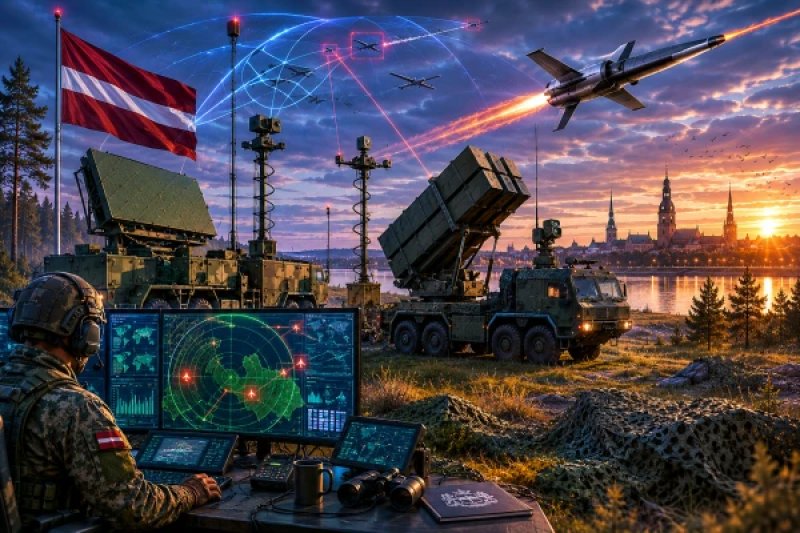
The Commander of the National Armed Forces, Kaspars Pudans, stated that in wartime, the main task of the air defense system will be to protect the most important objects in the country. According to him, this primarily concerns large populated areas and critical infrastructure facilities, the functioning of which is essential for the operation of the state. Pudans noted that Latvia needs to significantly expand its capabilities for detecting aerial targets, especially drones, which are increasingly becoming a threat to regional security. One of the main problems remains the insufficient number of radars capable of monitoring airspace at low altitudes. According to the commander, the existing system tracks objects well at altitudes above one kilometer, but there are significant gaps below this level. This was demonstrated by a recent incident in Latgale, when a drone fell into Lake Driģe and was not detected in time by early warning systems. In this regard, the National Armed Forces have already prepared proposals for the procurement of additional radars and are negotiating with manufacturers. However, the situation is complicated by high global demand. Today, many countries, including those in the Middle East, are actively acquiring such systems, which increases competition and the cost of equipment. At the same time, Latvia hopes to expand cooperation with Ukraine. The NAF is interested in acquiring Ukrainian electronic warfare systems, autonomous platforms, and various types of drones. A decision from the Ukrainian side regarding the possibility of exporting the relevant technologies and equipment is currently awaited. The commander emphasized that part of the necessary solutions can already be offered by the Latvian industry. Testing of locally produced interceptor drones is ongoing in the country. The first complexes have already been delivered to the armed forces, and new deliveries are expected in June. It is important to understand that even with a significant increase in defense spending, creating a system capable of fully protecting the entire territory of the country from aerial threats would require colossal resources. Therefore, the army has to set priorities and concentrate forces on the most important areas. Pudans also acknowledged that even with the necessary equipment, there are personnel limitations. According to him, the existing air defense units can be fully deployed simultaneously, but after a few days, the issue of personnel rotation arises. Without changing operators, the effectiveness of monitoring and detecting targets begins to decrease. The commander cited Israel as an example, noting that creating a similarly scaled air defense system would require huge financial investments. Separately, Pudans commented on the issue of information exchange with Ukraine regarding possible drone routes. According to him, cooperation is developing; however, Kyiv cannot disclose its operational plans in advance, as this could indirectly warn the Russian side. The topic of air security remains particularly relevant after a series of incidents in recent months. Residents of Latgale and Vidzeme have repeatedly received emergency warnings about drones, and some devices have already fallen and exploded on Latvian territory. The most resonant incident occurred in May in Rēzekne, where a drone exploded at an oil depot. Although there were no casualties, the incident caused a serious political reaction and became one of the factors in the subsequent government crisis. According to statements from the NAF, strengthening control over airspace and combating drones will be among the main directions for the development of Latvian defense in the coming years.