

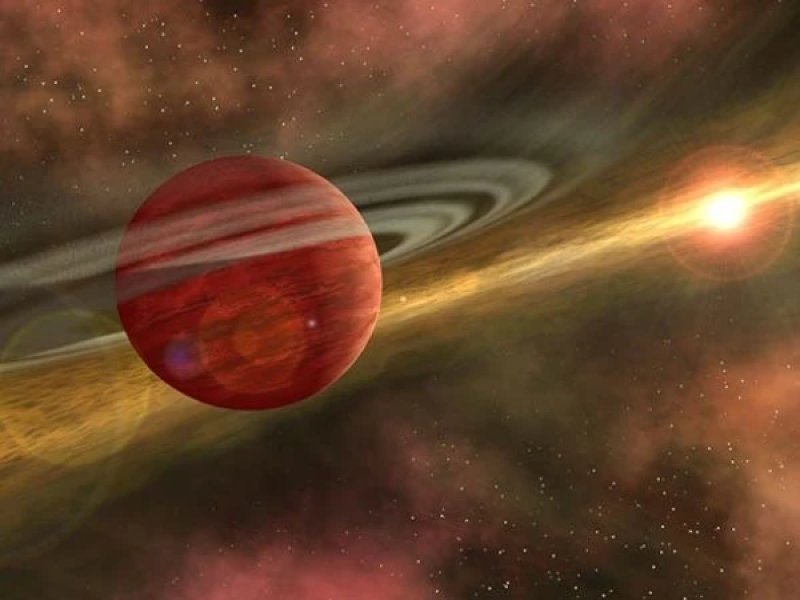
 Foto: BB.LV / Появление космических объектов перестало быть тайной.
An international team of researchers from the University of Warwick, the Massachusetts Institute of Technology, and McMaster University has developed a new method for determining the mass of young planets hidden in dense dust rings around their stars. These rings, known as protoplanetary disks, are the cradles of worlds where material gradually coalesces from dust into full-fledged planets. However, due to the abundance of dust, directly observing the planets themselves is extremely difficult, and until now, astronomers have been unable to accurately link the features of the disk structures to the mass of the objects hidden within them. Thanks to advancements in observational technology, particularly the use of the ALMA telescope in Chile, scientists have gained the ability to study protoplanetary disks in detail and discovered that they consist of distinct ring structures. Researchers have long suspected that these rings carry information about newborn planets but lacked the tool to decode it. "These bright rings are not just beautiful structures; they are literally fingerprints of the planets," explained the lead author of the study, Amena Faruki, a graduate student at the University of Warwick. "By reading 'between the lines' of these rings, we found a way to reconstruct the masses of the planets that create them, even when the planets themselves are too faint or deeply hidden to be observed directly." The team developed complex computer simulations to understand how different planet masses affect the shape of the dust rings. Analysis of the models revealed three key features in the ring structure that are important for characterizing the planet: the width of the ring, the amount of dust within it, and the brightest point of the ring. The brightest point turned out to be particularly significant: it is directly related to the mass of the planet and does not depend on external factors such as the size of the dust particles or the wavelength of observations. According to the scientists, using just this one parameter, it is possible to determine the mass of a hidden newborn planet, even without knowing the specific conditions in the disk. As a test of the method, the researchers turned to the PDS 70 system—one of the few where planets inside the disk have been photographed directly. By applying their new technique, based on measuring the brightest point of five rings, the team obtained a mass value that is extremely close to the results of other estimates. "One of the strengths of this work is that it remains not only in the realm of theory," noted co-author Dr. Jessica Speedy from MIT. "Using the PDS 70 system as an observational laboratory, we were able to conduct a real test of our approach, which gives us confidence that these methods are ready for widespread application." The simulation results also showed that in typical disks, more massive forming planets can hold in their rings an amount of dust equivalent to the mass of 20 Earths. This confirms data from ALMA observations but simultaneously raises a new question: why have no new planets been found within this captured dust and pebbles? The absence of such formation will be an important direction for future observations and theories. The team emphasizes that their work provides observers with a practical tool for directly determining planet masses from dust rings, and the time for this is now most opportune—considering the increasingly detailed images from ALMA and the emergence of new observatories in the near future.
