

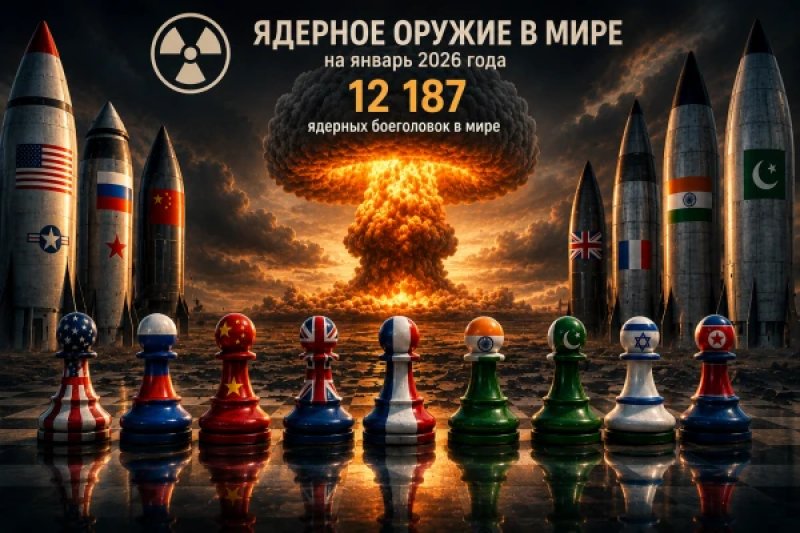
All nine countries possessing nuclear weapons — the USA, Russia, the UK, France, China, India, Pakistan, North Korea, and Israel — continued to modernize their nuclear arsenals in 2025. Most of them deployed new weapon systems or means of delivering nuclear warheads. This is stated in the annual report of the Stockholm International Peace Research Institute (SIPRI), published on June 8. According to the institute, as of January 2026, the global stockpile of nuclear warheads was approximately 12,187 units. Of these, about 9,745 were in military arsenals and could be used if necessary. Approximately 4,012 warheads were deployed on missiles and aircraft, while between 2,100 and 2,200 were in a high state of readiness on ballistic missiles. Almost all of this arsenal belongs to Russia and the USA. After the end of the Cold War, the number of nuclear weapons in the world gradually decreased, as the pace of dismantling old warheads in the USA and Russia outpaced the production of new ones. However, SIPRI analysts warn that this trend may change. According to their estimates, disarmament is slowing down, while the deployment of new systems is accelerating. SIPRI Senior Researcher Hans Kristensen noted that nuclear powers are increasingly postponing or ignoring disarmament commitments, contributing to a heightened global arms race. The institute's director, Karim Haggag, added that the threat is exacerbated by the development of new technologies, the weakening of arms control mechanisms, and rising geopolitical tensions. ### Russia and the USA Maintain Dominance Russia and the USA still control about 83% of the world's nuclear warhead stockpiles. Although the size of their arsenals did not change significantly in 2025, both countries continue extensive modernization programs. The report notes that Russian programs have been affected by Western sanctions and significant expenses related to the war in Ukraine. Tests of the intercontinental missile "Sarmat" ended in failure; however, the cruise missile "Burevestnik" successfully completed tests with a range of over 14,000 kilometers after a series of previous issues. Russia has also begun constructing infrastructure for the deployment of the "Oreshnik" missile system in Belarus. In May 2026, this system was used against Ukraine in a non-nuclear configuration. Experts note that the anticipated sharp increase in the number of Russian non-strategic warheads has not yet occurred. However, in the future, the Russian arsenal may increase by deploying more warheads on existing carriers. Additional uncertainty is created by the expiration of the New START treaty in February 2026. The United States is also facing difficulties in modernizing its nuclear forces. Rearmament programs are experiencing funding and planning issues, leading to increased project costs and the risk of delays. The situation is complicated by Donald Trump's initiative to create the "Iron Dome" missile defense system, estimated to cost $1.2 trillion. ### China Rapidly Expands Its Potential China is increasing its nuclear arsenal at the fastest pace. According to SIPRI estimates, by early 2026, China had approximately 620 warheads. Beijing has already deployed hundreds of missiles in three major silos in the northern part of the country and continues to build new facilities. Currently, about 30 more silos are under construction in eastern China. Even if China's arsenal exceeds one thousand warheads by 2030, it will still be significantly less than the stockpiles of Russia and the USA. ### Europe Strengthens Nuclear Deterrence Amid changes in global security, European countries are also reassessing their defense strategies. In March 2026, French President Emmanuel Macron announced plans to increase the French nuclear arsenal and stop disclosing its exact size. Paris is already consulting on nuclear cooperation with Germany and the UK. A number of European countries, including Germany, have expressed interest in creating additional nuclear deterrence mechanisms alongside the existing NATO system. The UK, for its part, has decided to acquire 12 F-35A fighter jets capable of carrying American nuclear bombs. This decision marks a departure from the Royal Air Force's nuclear disarmament policy that London has adhered to since the 1990s. SIPRI experts warn that the world is gradually moving away from the era of nuclear arsenal reductions. Against the backdrop of deteriorating international conditions, the weakening of arms control treaties, and accelerated modernization of nuclear forces, the risk of a new global arms race is becoming increasingly real.