

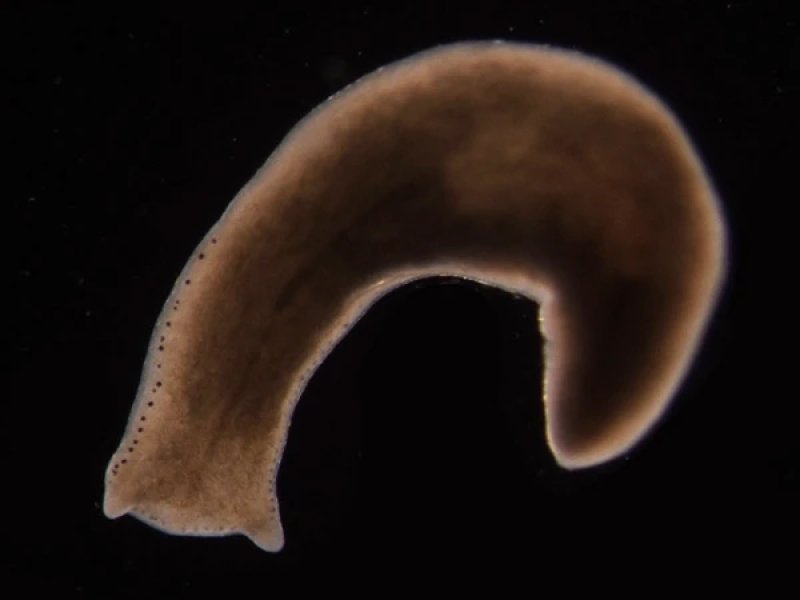
Researchers from Ben-Gurion University, in collaboration with American colleagues, have discovered a unique type of immune cells that explode under the influence of a hormone and destroy their neighbors. In flatworms – planarians – scientists found a previously unknown type of immune cells that completely disappear within seconds, exploding like a bomb. The researchers discovered these cells while studying the rejection reaction of foreign tissues in worms. It turned out that upon contact with a foreign organism, there is a sharp spike in the hormone activin, triggering an inflammatory process. This process is so rapid and powerful that the scientists compared it to a fire. The work is published in the journal Cell. Using microscopy, the scientists observed that the isolated group of cells responds to activin with immediate destruction and the release of contents that annihilate dozens of neighbors. The authors named this process ruptosis. Unlike some mammalian and bacterial cells, whose death stretches over hours, ruptosis in planarians lasts seconds. Experiments showed that ruptoblasts successfully destroy Escherichia coli bacteria, human kidney cells, and mouse blood cells. Moreover, the area of damage is limited exclusively to the explosion zone and does not cause a chain reaction or persistent toxicity. The scientists note that ruptoblasts are gland cells, not blood cells, and release toxins due to a sharp increase in calcium levels. Such cells have been preserved only in primitive bilaterally symmetrical organisms. It is likely that during the course of evolution, vertebrates lost them, as they do not possess the powerful regenerative abilities of planarians. According to the authors, the localized nature of ruptosis opens up great prospects for developing methods for targeted treatment of bacterial infections and tumors in humans.