

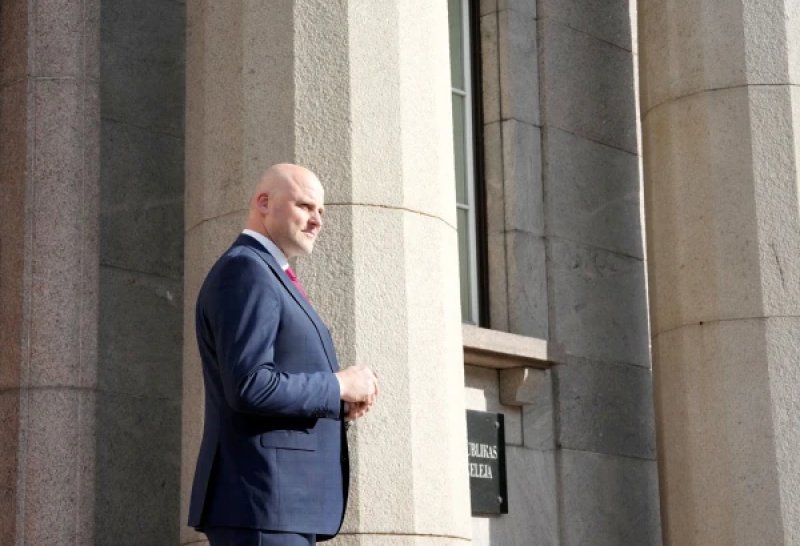
"I also have thoughts that go a bit beyond the usual approach. If over the next few weeks I can assess that this idea is viable, then I have already promised that the Prime Minister of Estonia will be the first to know how we could advance this project more quickly," said the Prime Minister of Latvia, Andris Kulbergs, mysteriously. Latvia currently lacks €3.7 billion to implement the project on time. Kulbergs was confident that he would find funding opportunities, but he does not consider it reasonable to build the railway at any cost. "We are trying to do everything possible to complete the work on time, but if the price is too high, it becomes problematic. So if we are trying to do something at any cost, then that price becomes too high," Kulbergs reflected. Kulbergs promised to discuss Rail Baltic with the President of the European Commission, Ursula von der Leyen, as he believes that Europe should now have a different attitude towards Rail Baltic than before. "This project is extremely important now, considering military mobility as well. We cannot finance it in the way we have done so far, when it comes to small contributions. Therefore, if we are dealing with a military project, it means that the financial contributions must correspond to that," said the Prime Minister of Latvia. ## Estonians Do Not Trust the Latvian Government According to Estonia's State Auditor Janar Holm, Latvia will objectively not be able to complete its section of the railway on time, and the amount of funds that need to be invested in the project in a short time is very large for Latvia. Holm noted that the three Baltic countries want to receive an additional €10 billion for Rail Baltic in the next EU budget period, of which Estonia is requesting only €1.2 billion. However, in the previous two periods, only a total of €4 billion was obtained. "Just a few months ago, the Ministry of Climate of Estonia said that Latvia is two years behind the project compared to Estonia. At the same time, we know that Estonia will make it on time. If we take this statement into account, then a two-year delay means at least 2032," said the State Auditor. It is important for Latvians to provide more precise information on the timelines and schedule for completing the railway, after which it would be reasonable for Estonia to conduct its calculations. "Because if Estonia completely halts work, everything will become more expensive. Take Rail Baltic Estonia, for example – you have about 200 employees, a little less. Will these people just wait and not work all this time? Such calculations need to be made considering various aspects. The fact is that the delay by the Latvians will cost us dearly in any case, and in my opinion, this is a problem," Holm explained.