

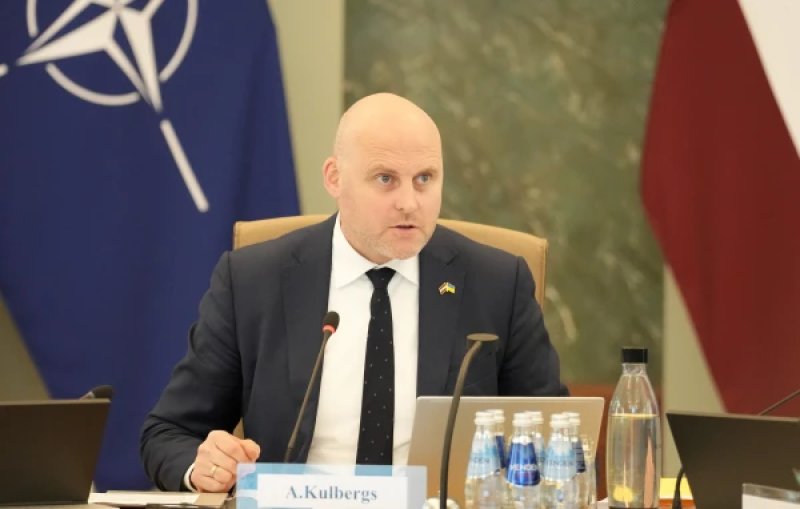
## A Glimpse into the Prime Minister's Office In a way, we should even thank President Edgars Rinkēvičs for daring to undertake such a bold experiment – nominating an opposition politician as Prime Minister who, moreover, had no political experience before being elected to this Saeima nearly four years ago and came to parliament from business. This allowed for a Prime Minister with a "fresh perspective," capable of viewing the entire executive branch in a new light... What will come of this experiment – we will see soon. In any case, Andris Kulbergs, in his two weeks as head of the executive branch, has already been surprised several times and perhaps even fallen into despair, having "suspected" or rather realized that he won't be able to move mountains, nor will he be allowed to. ## Three "Discoveries" of Kulbergs So, what "discoveries" awaited the recent parliamentary opposition member in the position of Prime Minister of the Republic of Latvia? **First discovery.** The Prime Minister's schedule – at least on working days – is packed from morning till evening to the point that there is "no room to breathe." Coalition council, government meetings, various commission meetings, protocol events, meetings with delegations, with social partners... Moreover, Kulbergs recklessly stated that he would hold Cabinet meetings not once a week, but at least twice! **Second discovery.** The legislation is structured in such a way that any subordinate acts (Cabinet rules) must go through the government. As a result, the agenda of each government meeting is filled or, as Kulbergs put it, clogged with endless technical rules and amendments to them. The Cabinet is forced to consider tariffs for services of the Maritime Registry or the Environmental Protection Service, changes to the rules regulating the slaughter of livestock in cases of dangerous infections, rules for bull insemination, or the operation of cash registers. It is clear that all of this could be resolved at the level of sectoral ministries or departments. But this government has been allocated too little time – the system cannot be broken in 4-5 months. Therefore, Kulbergs has no choice but to grit his teeth and get used to the national peculiarities of public administration. **Third discovery** or, if you will, the Prime Minister's revelation. Real life differs from opposition dreams and populism. Just recently, while in opposition, Kulbergs and other party members lamented: why has Latvian business not yet severed ties with Russia and Belarus?! They claimed that if desired, all trade relations with these countries could be cut off in a single day. Just in March, Kulbergs stated from the Saeima podium: "Ms. Silin has one very bad trait that costs all of Latvia dearly – she is too slow to realize things. To sever trade ties with Russia in the fifth year of the war? Bravo!". At that time, he also criticized the fact that the railway tracks towards Russia had not yet been dismantled. Now, having become Prime Minister and familiarized himself with the real situation, Kulbergs has cooled down a bit and understood: everything is only simple when you play the role of an armchair expert and bear no responsibility for the country (or sector). Kulbergs, for example, realized that Latvian pharmaceutical companies cannot abruptly sever business ties with Russia and Belarus. This is a very specific business, and it takes many years to conquer other markets – the process of certifying medications is very long and complicated, not to mention the fierce competition in the pharmaceutical market. At the same time, the state itself is not allowed to invest directly in private pharmaceutical businesses to help diversify markets. The most the government can do is provide export guarantees. ## Urgent Tasks Exist, but There Is No Money for Them One way or another, the surprise will soon pass, and Kulbergs will realize that he will have to chase two hares. On one hand, he must try not to fail in addressing urgent tasks (for example, regarding the fate of airBaltic), and on the other hand, considering the upcoming elections, he must deliver at least some gifts to the people, that is, make decisions favorable to voters. Let’s start with urgent tasks. Even before Ligo, the management of airBaltic must present a business plan to the government. Moreover, dealing with the business plan will not only fall to the Ministry of Transport – Kulbergs, upon taking office as Prime Minister, stated that he would take responsibility for overseeing two mega-projects (or rather two mega-problems) – airBaltic and Rail Baltica. Moreover, it is quite clear that there are no good solutions for airBaltic. Even if the airline's management proposes the most brilliant plan, it will still require additional financial injections – even if in the form of loans – from the state. And this will be an extremely unpopular decision. As for Rail Baltica, Kulbergs and his team will need to come up with ways to further reduce the project's costs before the elections. That is, what else can be abandoned during the project's implementation in Latvia to cut planned expenses. After all, Brussels has warned that it will only provide as much as was originally planned. And that money will not even be enough for the main route! Of course, the Latvian treasury does not have extra hundreds of millions to cover the funding deficit for the project of the century. In general, no good solutions are in sight here either. ## How Could We Not Promise And what about gifts for the people? Due to the acute shortage of funds, and time, Kulbergs and his team are unlikely to be able to delight voters with a plethora of positive decisions. The most the new government can do is issue promises to the people. They might say that after the elections, they will introduce basic pensions, raise family allowances, and even possibly return to the topic of seizing savings in the second pension level... However, Kulbergs and his United List, unless something extraordinary happens, can still receive many votes from the electorate, as part of the electorate from "New Unity" and even part of the electorate from the National Alliance may switch to the Prime Minister's party, as well as a significant portion of voters from the Union of Greens and Farmers. Ironically, all these political forces fighting for the same electorate are now working in the same government! And during the election campaign, they need to manage to maintain some coalition collegiality and attempt to take voters from their partners. It will be interesting – let’s grab some popcorn and watch.