

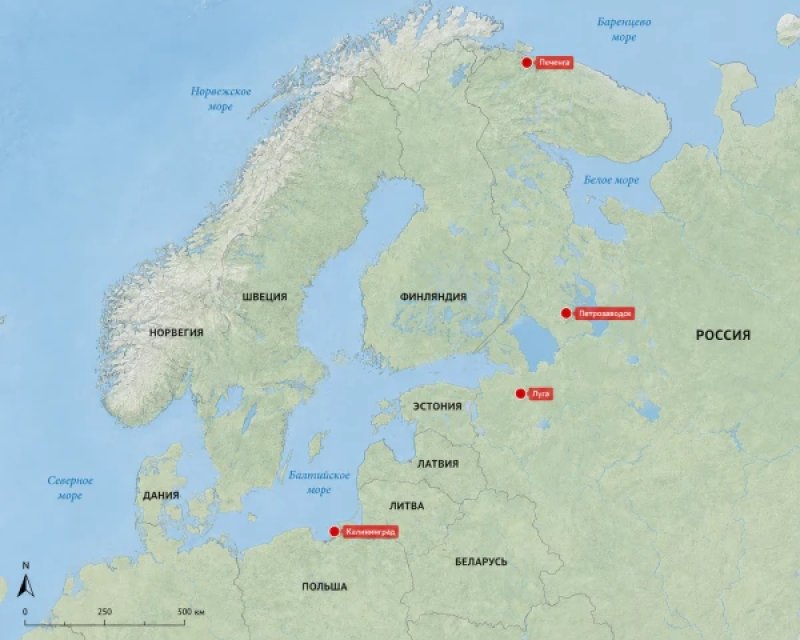
Russia is actively increasing its military presence in the northwestern direction and is creating new facilities near the borders of NATO countries in Northern Europe and the Baltic States. This conclusion was reached by journalists from the Swedish public broadcaster SVT and Norway's NRK, who analyzed satellite images of Russian military sites. The photographs captured new barracks, ammunition depots, equipment, and construction work in several areas. This includes the Pechenga district near the border with Norway, Petrozavodsk, the settlement of Sapyornoye near the border with Finland, the Luga district (closer to the Baltic States), as well as the Kaliningrad region. Particular attention was drawn to the base in the Pechenga district. It is currently designed for approximately 7,000 servicemen, but after modernization, its capacity could increase to 17,000 people. According to the commander of the Finnish army, Pasi Velimäki, the number of Russian troops near the Finnish border could potentially grow from the current approximately 20,000 to 80,000 servicemen. In total, all the facilities that the journalists investigated could accommodate up to 115,000 people. Military and intelligence structures in the region are closely monitoring the situation. The head of Swedish military intelligence, Thomas Nilsson, stated that such an expansion of infrastructure should not be perceived as a demonstrative step. According to him, it is about creating potential for possible confrontation with NATO in the future: > "This is a threat that we must take seriously (...). We do not believe that all this is being done merely for demonstration. It is about preparing the potential for possible confrontation with NATO in a large-scale conflict in the future," Nilsson stated. Experts also point out another feature: a significant part of the new facilities is currently not filled with personnel. It is assumed that their active use may begin after the completion or freezing of Russia's war against Ukraine. The commander of NATO forces in the Baltic States and Poland, Major General Brian Nissen, noted that currently, Russia's main resources are concentrated on the Ukrainian front. However, the situation could change quickly if active hostilities cease. What is important to understand is that this is not about the immediate transfer of 115,000 servicemen, but about creating infrastructure that will allow for such a number of troops to be stationed in the future. Concerns regarding the situation are also expressed in Norway. The commander of the country's armed forces, Eirik Kristoffersen, stated that if Russia indeed implements plans to increase its grouping to the declared scale, the level of military threat to the region will rise. Against the backdrop of Finland and Sweden's accession to NATO, the northern direction is becoming one of the key areas for long-term military planning for both Russia and the alliance countries.