

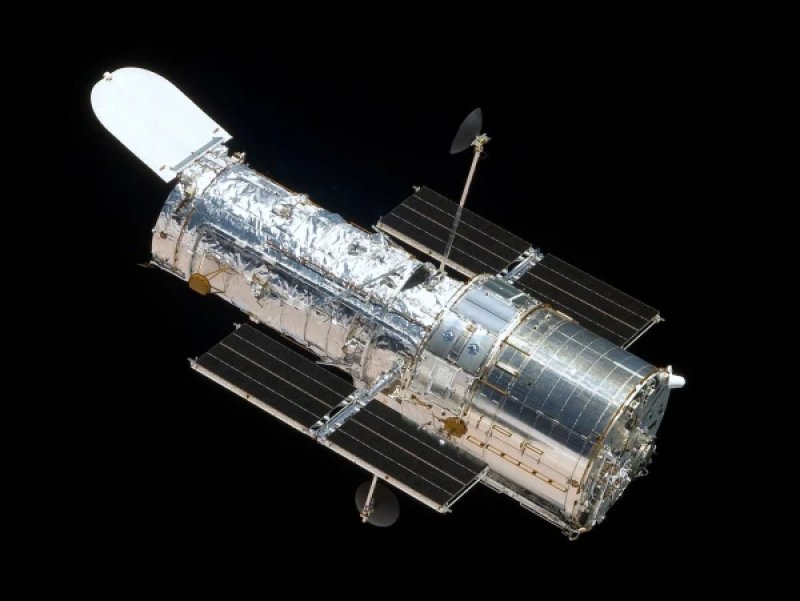
At the American Astronomical Society conference in January, the director of the Space Telescope Science Institute, Jennifer Lotz, stated that calculations of the telescope's orbit indicate the most likely date for its deorbiting around 2033. Therefore, the decreasing cost of orbital operations makes the idea of raising the 'Hubble' orbit increasingly attractive. However, there is a serious obstacle: operating the 'Hubble' is extremely expensive. In the 2025 fiscal year, NASA spent $98.8 million on the telescope. Among active astrophysical missions, only the 'James Webb' receives more funding. The specific level of cost reduction necessary for project approval has not yet been disclosed. If the issue can be resolved and the 'Hubble' orbit is indeed raised, the legendary telescope could continue to operate for many more years. The Hubble Space Telescope (HST; observatory code '250') is an automated observatory (telescope) in Earth's orbit, named after the American astronomer Edwin Hubble. 'Hubble' is a joint project of NASA and the European Space Agency and is part of NASA's Great Observatories. It was launched on April 24, 1990. Placing the telescope in space allows it to register electromagnetic radiation in ranges where the Earth's atmosphere is opaque, primarily in the infrared range. Due to the lack of atmospheric interference, the telescope's resolution is 7–10 times greater than that of a similar telescope located on Earth.