

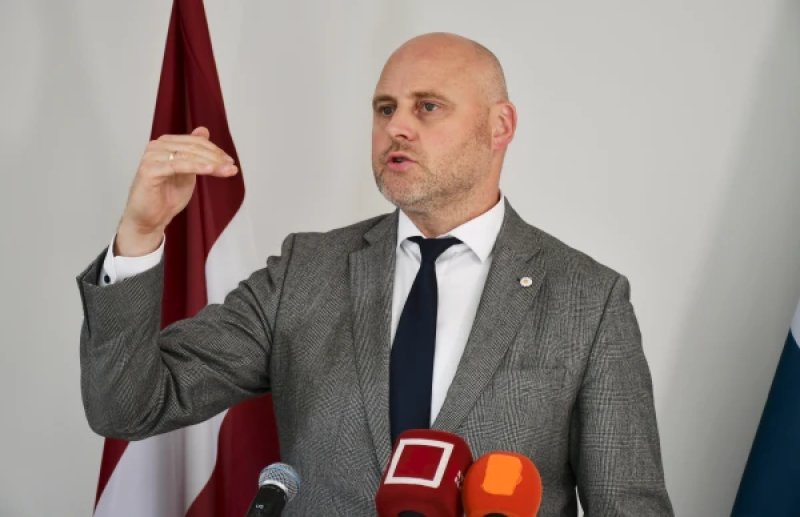
But... all these bold statements were made by the Prime Minister before he took office and got acquainted with the real situation. Now, the head of government no longer elaborates on revising the current budget. First, because this government has too little time before the elections, and opening the budget on the eve of the hour "X" is not a very rewarding task. Secondly, upon closer analysis, it turned out that it would not be possible to achieve significant savings anyway. Even if all government officials were deprived of bonuses, the savings would amount to at best 3-4 million euros. Against the backdrop of the overall budget (over 17 billion euros) — this is a drop in the ocean, and the electorate in the form of officials from the United List and other ruling parties could lose! ## Empty Efforts There is only one option left – to try to cut expenses in the 2027 budget project. However, this may also turn out to be... empty efforts if, as a result of the elections, a different coalition is formed that will adjust the 2027 budget and subsequent years (and now budget parameters will be planned not for three, but for four years ahead!) to its priorities and its understanding of the main financial law of the country. In any case, Kulbergs is right about two things: Latvia spends too much on public procurement (significantly more than the EU average) and on administrative expenses. Cutting these items could save about half a billion euros a year! At the same time, it is quite obvious that neither this government nor the next one will be able to contain the growth of public debt, which, in fact, was recently acknowledged by Finance Minister Maris Kucinskis. ## The EU Wallet Is Not Elastic Thus, the most that the current and even the next government can do in the current situation is to reduce the rate of growth of public debt. And it is not a fact that this will be successful, given the projected slowdown in economic growth. It is clear that hopes for economic growth of 3-3.5% of GDP, which our authorities counted on, have not materialized — it would be good if the growth at the end of the year reaches 2-2.5%. And this is not enough to significantly increase budget revenues and ensure funding for key priorities, including defense and healthcare. Interestingly, the management of Rail Baltica has already warned: it is impossible to build the railway solely with EU funds. In simple terms, this means that Latvia, Lithuania, and Estonia will have to think about where to find additional funding – either from private investors, which is unlikely, or through loans, or from the state budget. The last option for Latvia, with its extremely high budget deficit, is practically unrealistic... Especially since we are talking about completely fantastic amounts — 2-3 billion euros! ## Where to Find 3 Percent Growth?! Former Finance Minister and now Saeima deputy Arvils Aseradens has presented ideas on how to spur the Latvian economy. The immediate question arises – what prevented Aseradens from implementing his ideas while he was a member of the government? Nevertheless, let’s listen to the former minister. After all, hindsight is always 20/20. "We must be able to achieve growth of 3-3.5% per year in the long term. Without this, it will be very difficult to finance the growth of defense spending. **First**, we must understand that large companies form the backbone of the economy. In Latvia, we too often talk only about small enterprises, but it is the large enterprises that can integrate into global value chains and bring faster growth. **Second**, productivity. Here we have very serious problems. Wages have been growing faster than productivity for a long time. No economy can withstand this in the long term. We are starting to lose competitiveness. **Third**, automation, digitalization, and artificial intelligence. And I want to emphasize – true digitalization, not just electronization. We often transfer a document from paper to computer and call it digitization. This is not digitalization. Artificial intelligence is now referred to as the fourth industrial revolution. If we can use it correctly, the benefits will be enormous," said Arvils Aseradens, head of the Saeima Economic Commission, in an interview with nra.lv. ## Tasks for the New Government For large enterprises – primarily state-owned – to bring in more profit, it is necessary to reform their management and allow them to operate more actively in external markets. As for labor productivity, politicians have been talking about this for the last two decades, and... the situation remains unchanged. In terms of labor productivity, we occupy one of the last places in the EU. Meanwhile, salaries in public administration continue to rise... However, salaries in the private sector are also increasing, but this is related to a severe shortage of labor... In general, the government has no simple and quick solutions to stimulate economic growth. The situation is exacerbated by the complex geopolitical environment... It is clear that the problems of economic growth and increasing competitiveness will have to be addressed by the new government and the Saeima.