

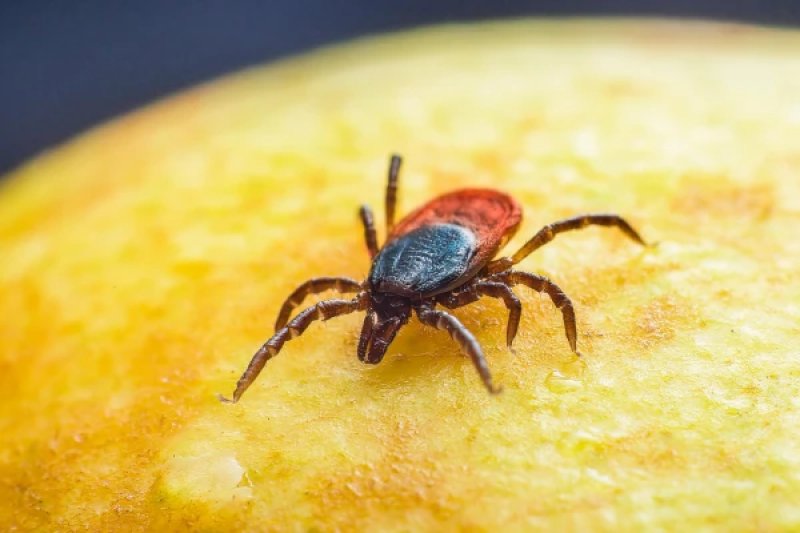
 Foto: BB.LV / Клещ
Last year, Lyme disease was registered in 539 residents of Latvia. This is the highest incidence rate in the last 13 years, according to data from the Disease Prevention and Control Center (SPKC). The last time more cases were recorded was in 2012, when Lyme disease was identified in 724 people. Lyme disease, or borreliosis, is a bacterial infection transmitted to humans by infected ticks. The disease is significantly easier to treat when detected early; however, late diagnosis can lead to infection affecting the joints, nervous system, and heart. Entomologist Voldemars Spungis reported that in recent years, the proportion of ticks carrying the Borrelia bacteria—the causative agent of Lyme disease—has significantly increased in Latvia. According to him, currently between 50% and 70% of ticks may be infected with this bacteria, which is one of the highest rates in recent years. Spungis noted that the proportion of ticks carrying Borrelia has been steadily increasing in recent years. He also explained that Lyme disease is a relatively "young" disease for Latvia, and its spread largely depends on the population of wild animals in a specific area. "The Borrelia bacteria live in the intestines of animals and constantly circulate in nature between ticks and wild animals. A tick attaches itself to, for example, a hare, becomes infected with the bacteria, then the hare is eaten by a fox, after which the infection can be transmitted to other animals. This forms a natural cycle of infection, which can also involve humans," the entomologist explained. According to him, the more both small and large wild animals there are, and the greater their diversity, the more favorable the conditions for the spread of infected ticks. This is especially true for abandoned natural areas. "Wild animals are a kind of reservoir where Borrelia bacteria accumulate. In areas inhabited by small animals—such as voles, hedgehogs, and hares—the population of foxes, other predators, and large forest animals increases, creating a favorable environment for the circulation of the infection," the specialist explained. ## How to protect yourself from ticks The SPKC reminds that ticks most often attach to humans at a height of 5–15 centimeters above the ground. Before going to the forest or meadow, it is recommended to wear clothing that prevents ticks from getting underneath. In particular, it is advisable to tuck pants into socks or boots and to choose clothing with tightly fitting cuffs and collars. Ticks can be found not only in the forest but also in urban parks or on private plots. Therefore, it is important to regularly mow the grass, remove last year's vegetation, not leave fallen trees and branches in the yard, and also to mow the grass under bushes. Children's playgrounds are recommended to be placed in sunny areas away from bushes and dense vegetation. During walks, specialists advise periodically checking clothing to notice and shake off ticks in time. They are easiest to spot on light-colored clothing. After returning home, it is essential to thoroughly check the body and clothing. Earlier, BB.lv [reported](https://bb.lv/statja/nasha-latvija/2026/07/05/eziki-potianulis-na-ucastki-ogorodnikov-latvii-pochemu-ix-lucse-ne-puskat) on why hedgehogs in your area are unwanted guests.
