

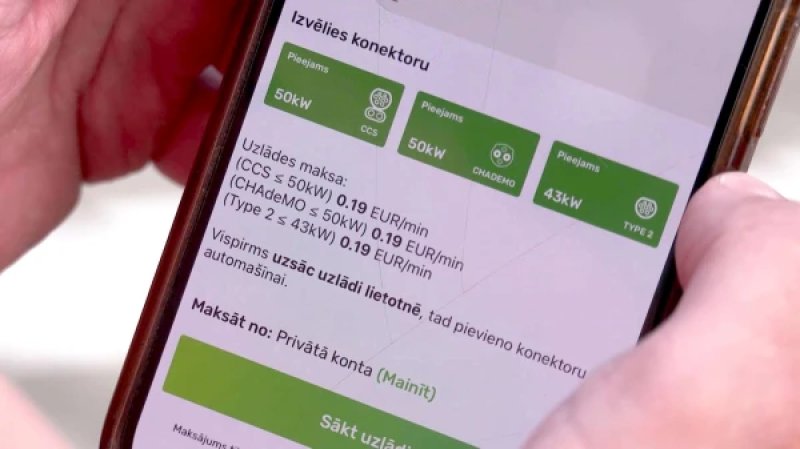
A user of the national charging station network E-mobi reported a significant discrepancy between the declared and actual charging power. According to him, this means that electric vehicle owners may end up paying more than they expected. This was reported by the show Bez Tabu ([TV3](https://tv3.lv/beztabu/transports/butiska-pakalpojuma-neatbilstiba-elektroauto-ipasnieks-vilies-nacionalaja-uzlades-staciju-tikla-e-mobi/)). The program's editorial office was contacted by Tesla owner Arturs. While charging at the E-mobi station in Smiltene, he noticed that the actual power was significantly different from the information indicated in the mobile application and at the station itself. It was stated that the equipment could deliver 43 or 50 kW depending on the connector used. However, according to Arturs, during the first 20-minute session, the average power was only 23.74 kW, and after reconnecting the car, it even decreased slightly to 23.12 kW. "The car showed that charging was happening at the maximum available power of the station. But since E-mobi operates on a time-based tariff, the charging speed directly affects the final cost of the service," he said. The electric vehicle owner noted that he observed a similar situation at other stations in the E-mobi network. Arturs believes that if specific technical specifications are indicated in the application and on the equipment, users have the right to expect that the actual parameters will match them. In his opinion, a deviation of about 50% should be considered a significant discrepancy in service quality. The Road Traffic Safety Directorate (CSDD), which services the E-mobi network, explained that the application and charging stations indicate the maximum possible power of the equipment, not the guaranteed charging speed. The directorate noted that several factors affect the actual power: the capabilities of the vehicle itself, the state of the battery, weather conditions, and other technical circumstances. Therefore, maximum values are not always achievable. However, Arturs disagrees with this explanation. According to him, before charging, he drove almost 150 kilometers, so the Tesla battery was in an optimal temperature range for fast charging and could accept significantly higher power. It is worth noting that the E-mobi network was the first in Latvia and was created to launch electric vehicle charging infrastructure across the country. Currently, the network is managed by CSDD, and it is expected that the directorate will be responsible for its operation for about another year. Observers believe that significant improvements are unlikely during this period. It is possible that the network may be handed over to private entrepreneurs in the future — in which case the situation may change. The issue of whether the declared characteristics match the actual operation of charging stations remains relevant, especially considering that in the E-mobi network, the cost of the service depends not on the amount of energy received but on the time spent at the charging station. For electric vehicle owners, charging speed affects not only convenience but also the final cost of each trip.
