

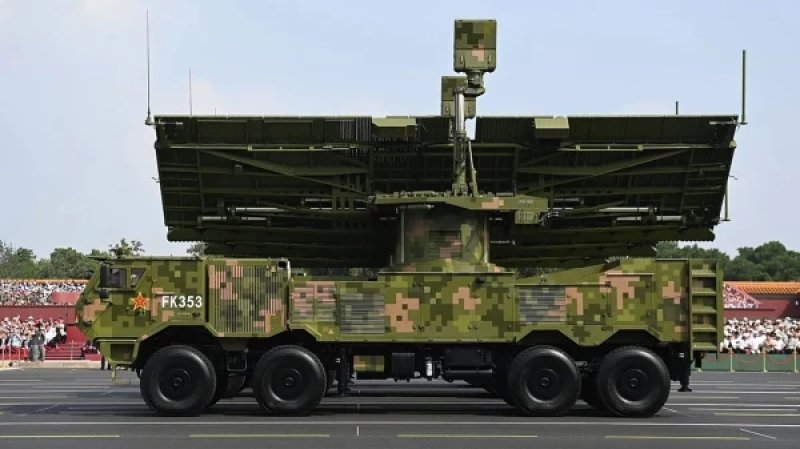
Among them, a device capable of reaching a power of 100 gigawatts stands out, achieved by combining several synchronized pulse generators, as explained by the researchers led by Zhang Jun. For comparison, a typical household microwave oven for heating food generates microwaves with a power of about 800 watts, or 0.0000008 GW. To grasp the scale of this magnitude: experts believe that a pulse of just 1 gigawatt can already cause serious interference or direct damage to the electronics of satellites in low orbit. The described NUDT system increases this power a hundredfold, and the authors of the work note that the design allows for further scaling. ## The key technical solution, as stated in the article, lies in synchronizing several compact pulse power modules instead of relying on a single generator, which is constrained by electrical insulation limitations. Such a modular architecture, according to the scientists, allows each block to operate almost at peak mode without degrading the overall performance of the complex. ## Why This Raises Concerns Among Operators of Major Satellite Constellations The strategic interest in this technology is not new. Back in February, China announced in another study the creation of a 20-gigawatt device developed by the Northwest Institute of Nuclear Technology, specifically designed as a potential tool for disrupting satellite networks like Starlink. Unlike kinetic weapons that destroy satellites with a direct hit and create debris clouds dangerous to any devices in orbit, including the attacker’s own satellites, microwave weapons affect electronics without physical contact. This provides, at least in theory, a dual advantage: low operational costs compared to the expense of orbital constellations that it can neutralize, and the ability to maintain ambiguity regarding the authorship of the attack, which conventional types of weaponry do not allow. The NUDT team itself acknowledges in the article that its goal is to achieve tens of gigawatts of output power under strict volume and weight constraints, which is a key condition if the system is to be integrated onto mobile or naval platforms. ## Additional Innovations and Context of the Arms Race The paper details other solutions, particularly solid-state systems designed for use in various combat conditions, as well as a hybrid based on lithium-ion capacitors capable of instant activation at temperatures down to −40 °C. This latter innovation is particularly important for electronic warfare units operating in winter or polar conditions, where extreme cold typically reduces the efficiency of power systems. The authors acknowledge that China initially has an advantage over other powers in this area and attribute it to years of continuous investment in high-power pulse research. Other countries wishing to catch up with China face, as emphasized in the article, obstacles such as the loss of industrial potential, reduced R&D spending, and difficulties in accessing critically important materials, including rare earth elements. The next stages of research, according to the article, will focus on improving the accuracy of energy beam control and reducing the size and cost of such systems—two key conditions necessary for the technology to move beyond laboratories and gain broader application.