

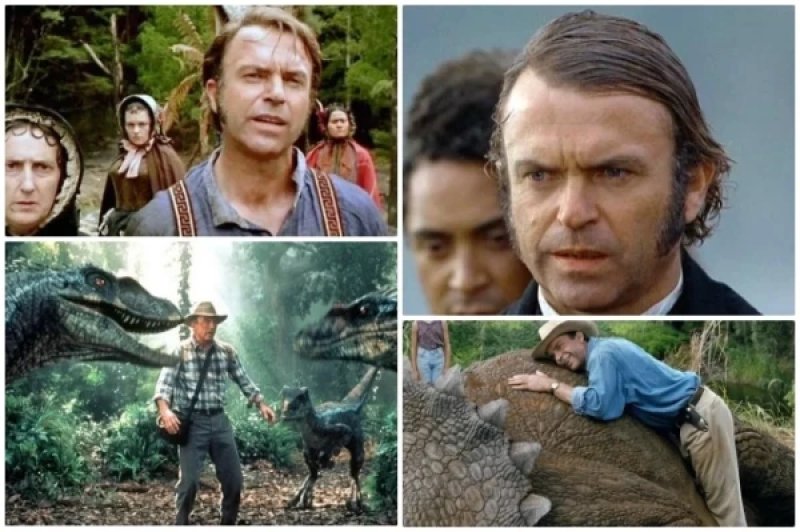
His passing, according to relatives, was a sudden and unexpected blow, despite the fact that the actor had bravely fought a serious illness in recent years. His loved ones noted that he was in remission after battling cancer. **Soft Power** Steven Spielberg, who introduced Neill to the world audience, called him "the soul who brought Alan Grant to life" and "a man of immense warmth and intellect." The director recalled how Neill came to audition in 1992 and immediately captivated the entire crew with his sincerity and that rare inner strength that combines with softness. "He didn’t just play a scientist," Spielberg said, "he was a scientist by nature: curious, ironic, and endlessly charming. Sam was one of those actors every director dreams of working with. He understood the story with half a word, bringing something of his own, elusive and real, to it." Director Jane Campion, who gave Neill a role in "The Piano," spoke of him as a "hidden treasure" of cinema. "Sam possessed a rare quality — he could be both strong and vulnerable at the same time," she recalled. "His character in 'The Piano' — rough, jealous, but at the same time vulnerable in his own way — succeeded precisely because of this duality. He wasn't afraid to show weakness on screen, and that made his characters incredibly human." Australian actor Hugh Jackman, who starred with Neill in the film "Australia" (2008), admitted that Sam was an example for him of how to remain a humble and kind person even at the peak of global fame. "When I came to the set, I was already quite well-known thanks to 'X-Men', but Sam treated me as an equal," Jackman said. "He never let his star status affect how he interacted with people. He reminded me of my father: reliable, wise, with a wonderful sense of humor." **From Northern Ireland to New Zealand** Sam Neill (full name — Nigel John Dermot Neill) was born on September 14, 1947, in Omagh, Northern Ireland. At an early age, he moved with his family to New Zealand, a country he later considered his true homeland. New Zealand became not just a place of residence for the future actor, but a source of inspiration. He graduated from the University of Canterbury with a Bachelor of Arts degree in English literature. There, within the university walls, he first seriously considered an acting career, starting to participate in student productions. In the late 1960s, he joined the New Zealand National Theatre company and began acting in classic productions. In 1977, a breakthrough occurred in his career: he landed the lead role in the film "Sleeping Dogs," which became his debut in feature films. The film was successful at festivals, and the young actor began to gain recognition. In the 1980s, he moved to the UK, where he actively appeared on television. The series "Ivanhoe," "Reilly: Ace of Spies," and "The Man Who Fell to Earth" earned him a reputation as a serious dramatic actor capable of playing both romantic heroes and complex, ambiguous characters. He was nominated for a Golden Globe for his role in the miniseries "Reilly" in 1983. It was also during this time that he had another fateful encounter — he caught the attention of Hollywood producers, and one project after another followed in the US. **A Master of All Roles** Neill's star moment came in 1993 when two films were released that made him a superstar. The first, undoubtedly, was "Jurassic Park" by Steven Spielberg. The role of paleontologist Alan Grant forever changed the actor's life. Initially, Harrison Ford was considered for the role, then Richard Dreyfuss, but both declined. When Neill came in for the audition, he instantly captivated the director with his naturalness. Neill later recalled that during the filming, he had to work with animatronic dinosaurs, which required immense patience, but he enjoyed the process because he believed in the magic of the film: "I just stood there and watched the robots opening their mouths, and at some point, I stopped thinking about the mechanisms and started seeing real animals. It was like childhood." He later returned to this character in "Jurassic Park III" (2001) and in the blockbuster "Jurassic World: Dominion" (2022). Interestingly, he initially did not plan to appear in the sequels and skipped the second part. But then the crew convinced him. With each new installment, Grant became a little wiser, as Neill brought new shades to the character, turning the paleontologist into a true philosopher who saw in ancient reptiles not just monsters, but a mystery that nature had gifted humanity. In the same 1993, the drama "The Piano" by New Zealand director Jane Campion was released. The film won the Palme d'Or at Cannes and three Academy Awards, including Best Actress for Holly Hunter. Neill brilliantly portrayed the husband of the main character — a complex, dark role far removed from the image of the paleontologist hero. His character, Mr. Stewart, was a cruel and domineering man who cuts off his wife's finger in a fit of jealousy. This role demonstrated that Neill was capable of playing antiheroes with chilling conviction. Many critics wrote that it was precisely because of this duality — the ability to be both a savior and a destroyer — that Neill became one of the most versatile actors of his generation. Later, he reprised the role of the difficult husband in the psychological thriller "Obsession" in 2006, alongside co-stars Susan Sarandon and Emily Blunt. Television also became an important part of his career. He appeared in the series "Peaky Blinders," where he played the sinister father Hughes in the third season, in the historical drama "The Tudors" (as Cardinal Wolsey), in the series "Invasion," and many others. His characters often had internal conflict and tragic depth. **Who He Didn't Play** Sam could have become James Bond (he was considered for the role in the 1980s in "For Your Eyes Only," but the role ultimately went to Roger Moore). Sam was also offered the role of Elrond in "The Lord of the Rings," but he declined due to commitments to other projects. In 2004, he could have become Doctor Octopus in "Spider-Man 2" (the role went to Alfred Molina), but director Sam Raimi thought Neill was too "nice" for a villain, although he later regretted that decision. In 2022, Sam was diagnosed with angioimmunoblastic T-cell lymphoma — a rare and aggressive form of blood cancer. For an actor who had always been known for his robust health and led an active lifestyle on his vineyard in New Zealand, this diagnosis was a shock. The first course of chemotherapy did not yield the desired results, and doctors offered the actor an alternative, innovative therapy using CAR T-cells. The essence of the method was that the patient's own immune cells were genetically modified to fight cancer and returned to the body. This procedure was risky, but ultimately led to remission. In April 2026, the actor happily announced that he had managed to overcome the illness. He jokingly stated that he could now shift his focus from health to work and would like to star in one more film. "I don’t know how much time I have left, but I definitely want to act until my last day," he said in an interview. He wrote a memoir titled "Did I Ever Tell You This?" in which he described his battle with illness and nearly half a century of career. The book became a bestseller, with many readers admitting they cried over the pages dedicated to his relationships with family and his candid fear of death. "I consider it an adventure, quite dark, but nevertheless an adventure," the actor shared in one of his last major interviews. He said he was not afraid of death, but would like to live at least another 10-20 years to see his grandchildren grow up. **Two Wives, Children, Grandchildren, and a Beloved Farm** Sam Neill was married twice. His first wife was Lisa Harrow, whom he married in 1989, but the marriage lasted only four years and ended in 1993 — the very year he became a global star. However, after some time, he met his true love — Heather Neill, with whom he lived until the end of his days. In this marriage, he had children, and it was Heather who became his main support during his battle with illness. The actor left behind children and grandchildren, whom he cherished deeply. In one interview, he admitted that it was for them that he wanted to live as long as possible. "When you have grandchildren, everything changes," he said with his usual smile. "You want to see them fall in love, make mistakes, grow up. You want to be there to lend a shoulder if needed. And that’s worth fighting for." He loved his vineyard in New Zealand, where he spent time between shoots. Neill was not just an actor; he was a farmer, a winemaker, a man of the land. When he wasn’t filming, he was pruning grapevines or harvesting, and this, he said, helped him stay fit and maintain a connection with reality. The actor's last works were films that will be released posthumously: the sci-fi blockbuster "Godzilla vs. Kong: The New Empire," where he played one of the key roles, and "The Last Resort" with Daisy Ridley. According to producers, he worked on these projects with incredible enthusiasm, despite his health condition. He did not complain, did not ask for leniency, but simply went on set and did his job.