

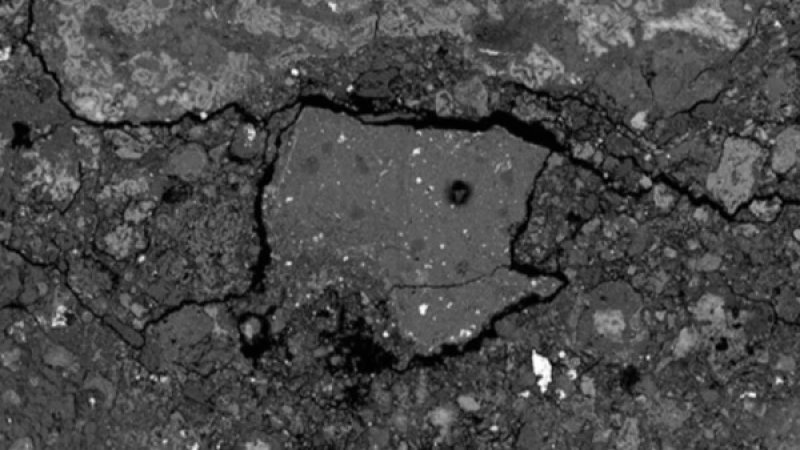
A rare meteorite weighing over a kilogram, which fell in July 2024 on a residential house in New Jersey, allowed scientists to gain new insights into the chemical processes that may have occurred even before the emergence of life on Earth. The research results were published in the journal Science Advances. On July 16, 2024, residents of several U.S. states observed a bright fireball flying over the northeastern part of the country. The celestial body entered the atmosphere at a speed of about 14.4 kilometers per second, broke apart at an altitude of over 35 kilometers, and one of its fragments pierced the roof of a house in Hillsborough. During the incident, no one was injured. The homeowners quickly collected the fragments using disposable gloves, glass jars, and aluminum foil. According to researchers, this helped avoid contamination of the sample and preserve it in nearly pristine condition. Analysis showed that the find belongs to an extremely rare type of carbonaceous chondrites — CM½. This is only the second such meteorite discovered after falling to Earth, and the first that has been studied in such good condition. The most unexpected discovery was the large number of organic compounds. "We found a complex set of amino acids — the basic building blocks of proteins. Most of them are either extremely rare on Earth or completely absent in terrestrial life, which confirms their extraterrestrial origin," said co-author of the study Danny Glavin from NASA's Goddard Space Flight Center. Among the compounds found was tryptophan — an amino acid involved in the production of serotonin and melatonin in humans. In addition to organic substances, scientists discovered a high content of sodium and traces of ancient saline minerals. This indicates that liquid brines — salty water that gradually evaporated and left behind minerals — once existed inside the parent asteroid. Such conditions are considered favorable for the formation of complex organic molecules. According to researchers, billions of years ago, similar meteorites could have regularly fallen on young Earth, delivering the organic compounds necessary for the emergence of life. Another feature of the find was its origin. According to scientists' calculations, the meteorite separated from an asteroid in the inner part of the main asteroid belt between Mars and Jupiter. After several collisions in space, its fragment traveled in orbit for about 200,000 years before reaching Earth. Researchers are also comparing the composition of the find with samples from the asteroids Bennu and Ryugu, which were brought to Earth by NASA's OSIRIS-REx and Japan's Hayabusa2 space missions. According to specialists, the diversity of amino acids found in the meteorite was even higher than in the samples brought directly from these asteroids. Currently, fragments of the meteorite are stored at the American Museum of Natural History in New York, where they continue to be studied. This find helps scientists better understand the role ancient asteroids may have played in the formation of the chemical "building blocks" of life on Earth.