

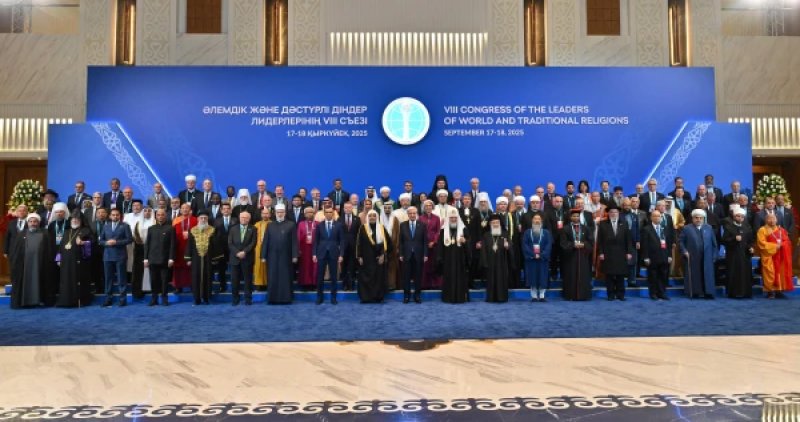
In such conditions, traditional diplomatic tools are sometimes insufficient. This is why other international mechanisms that can support dialogue across political, national, and confessional boundaries become particularly important. One such platform has been the Congress of Leaders of World and Traditional Religions in Astana. Established at the initiative of Kazakhstan in 2003, the Congress has evolved over more than two decades from a major international forum to a sustainable mechanism for interreligious and intercultural interaction. The Congress has responded to modern challenges, demonstrating that religion should be a source of reconciliation rather than conflict. Delegates from dozens of countries gather to discuss spiritual and social responsibility. At the last VIII Congress, held under the slogan "Dialogue of Religions: Synergy for the Future," more than 100 delegations from 60 countries participated. The main outcome of the forum was the adoption of the Astana Declaration of Peace 2025. The document proclaims the necessity of an absolute rejection of the use of religious rhetoric to justify wars and terrorism, as well as containing specific initiatives to strengthen interreligious dialogue and overcome global inequality. A significant event in the history of the interreligious summit was the visit of Pope Francis in 2022 to the VII Congress. This visit marked an important milestone for Vatican diplomacy and the world. The participation of the head of the Catholic Church confirmed the status of the Congress as a unique platform for dialogue, where open discussions on global security are possible. In this context, the term "spiritual diplomacy" is increasingly used. This does not mean replacing classical diplomacy with religious institutions or involving spiritual leaders in state politics. Spiritual diplomacy complements official mechanisms, creating additional channels of communication in situations where political dialogue is hindered. Religious leaders possess significant moral authority, are capable of addressing millions of people directly, and can influence public perception of conflicts, violence, and discrimination. Their united position can contribute to reducing tensions, maintaining humanitarian ties, and countering attempts to justify aggression with religious slogans. The peculiarity of the Kazakh approach lies in the desire to maintain the Congress as a neutral and depoliticized platform. Astana does not ask participants to renounce differences or develop a unified theological position. On the contrary, the essence of the forum lies in recognizing diversity and seeking common moral guidelines: respect for life, justice, responsibility, compassion, and peaceful coexistence. This model largely reflects Kazakhstan's internal experience as a secular and multi-confessional state, where social consensus is seen as a crucial condition for stability and development. An important sign of the practical orientation of the Congress has been the expansion of its themes. Proposals have been supported for the preparation of universal principles for the responsible use of artificial intelligence from the perspectives of spirituality and humanism, as well as a document on the role of religious leaders in combating climate change. In 2026, relevant projects were presented to the Congress's international partners. This shows that modern interreligious dialogue is no longer limited to issues of tolerance. It encompasses technological ethics, environmental responsibility, education, digital radicalization, and the situation of youth—issues that directly affect the future of humanity. Of course, the possibilities of spiritual diplomacy should not be overestimated. Religious forums cannot independently stop wars, eliminate geopolitical contradictions, or replace international law. Their real significance manifests in another way: they help preserve space for conversation, prevent the complete dehumanization of opponents, and remind us that even in times of crisis, there are universal norms that unite people regardless of their faith and background. Therefore, the effectiveness of the Congress should be determined not only by the number of participants and adopted declarations but also by how its ideas are embodied in educational programs, youth projects, expert recommendations, and international humanitarian initiatives. The next IX Congress of Leaders of World and Traditional Religions in Astana is scheduled for 2028. Until then, the organizers and partners of the forum face the task of turning the provisions of the Astana Declaration into a coherent action program. Kazakhstan has already established a recognizable international platform and offered the world its own model of spiritual diplomacy. Now its further authority will depend on the ability to connect moral appeals with practical results. In an era of global distrust, this could become one of Astana's most significant contributions to strengthening peace, mutual respect, and international understanding.