

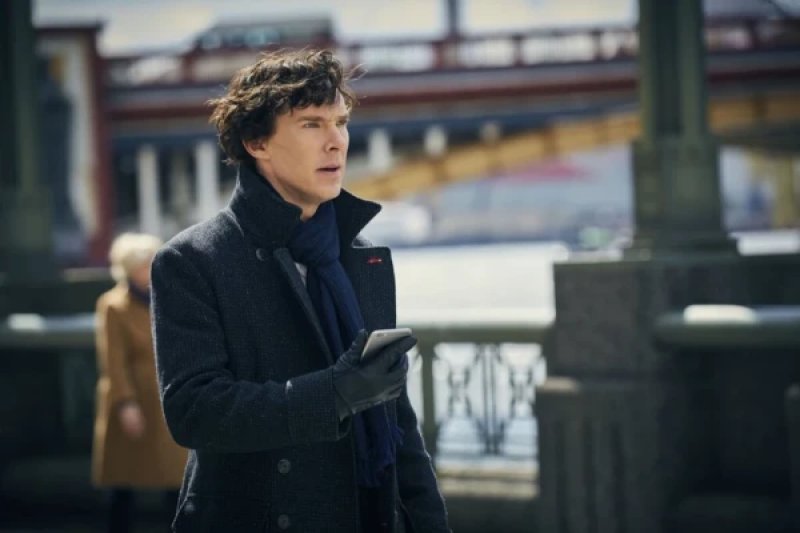
His mother, Wanda Ventham, like his father, Timothy Cumberbatch, became famous for their roles in television series. They did not want their son to become an actor: they understood the many pitfalls of this profession. Their popularity did not bring them much money; when Benedict was 14, they decided to send him to the prestigious Harrow School, but his grandmother, who owned a tea plantation in India, had to pay for his tuition. At this school, Benedict was hardly the richest student. "I studied with the son of Lord Rothschild, the son of Prince Hussein, future dignitaries, princes, and peers. Everyone was constantly going on fantastic trips, while I would say, 'Well, I'm going to visit my grandmother in Brighton.' He participated in many school plays (Harrow is a boys' school, so both male and female roles were played by boys - a practice that was also common in Shakespeare's time; among other roles, Benedict played Rosalind in 'As You Like It' and Eliza Doolittle in Shaw's 'Pygmalion'). As a young man, he was already firmly convinced that acting was his destiny. He made his on-screen debut in the long-running soap opera 'Heartbeat,' where, ironically, his parents had once acted as well. And then everything stalled for a long time: it was only in the 21st century, when he was nearing thirty, that he began to land roles in more or less decent films and series. But you probably don't remember him in 'Atonement' by Joe Wright or in 'The Other Boleyn Girl': significant roles were rare. However, there was the role of Stephen Hawking in a television film (Cumberbatch met the scientist on set, who ended up liking his performance). There was an expensive series 'Journey to the Edge of the Earth,' but it is mainly remembered for the adventure in South Africa (the car the actors were in had a tire burst at night, and they were immediately surrounded by robbers with guns demanding money and, for some reason, drugs. Explaining that there was neither money nor drugs was impossible. The bandits pretended to be about to shoot Cumberbatch, even throwing a blanket over his head, supposedly to muffle the sound of the shot. They miraculously managed to escape. Cumberbatch cried many years later while recounting this to interviewers)... And when he was 34, 'Sherlock' came out. Well, you might not remember Benedict in 'Atonement'; after all, he was completely overshadowed by the heartbreaking story of Keira Knightley, James McAvoy, and Saoirse Ronan. But producer Steven Moffat and his wife, also a producer, Sue Vertue, saw Cumberbatch in this film. They immediately called him for the role of a modernized Sherlock Holmes, a "high-functioning sociopath" who replaced his pipe with nicotine patches. Benedict was given the script, he read several scenes aloud - and that was it; they didn't audition anyone else. Later, the producers recalled that it was much harder to find an actor for the role of Dr. Watson - he had to complement Cumberbatch well on screen. They liked Martin Freeman because he "was the complete opposite of Benedict in everything except the scale of his talent" and that he "could find poetry in the image of an ordinary man." 'Sherlock' was a challenging project. The pilot, which the creators shot with the intention of making a mini-series of six episodes, was rejected by the broadcaster; they demanded it be completely reshot and instead of six one-hour episodes, three one-and-a-half-hour episodes be made. What eventually came out unexpectedly pleased everyone: first the British, and then the Americans glued themselves to their televisions, and Cumberbatch and Freeman received Emmys a few years later (although Benedict generally has bad luck with awards: he has far more nominations than statuettes, and he still doesn't have an Oscar or even a Golden Globe. However, he does have the Olivier Award - one of the highest honors for British stage actors. By 2014, critics were seriously calling him "the Laurence Olivier of a new generation" and "the closest descendant" of the greatest British actor of the 20th century). Additionally, immediately after the release of 'Sherlock,' he began to be included in lists of "Sexiest Living Men" and "Most Eligible Bachelors." People began to follow him on the streets, describing all his actions and every movement on social media (he initially got angry but then accepted it). According to surveys of foreigners, he was associated with Britain to the same extent as Shakespeare, the Beatles, J.K. Rowling, Elton John, and Elizabeth II. The latter made him a Commander of the Order of the British Empire in 2015. An otter was named in his honor at an aquarium in Tennessee. For Benedict himself, the most important thing was the offers for new roles that poured in abundantly after 'Sherlock.' Peter Jackson brought him and Freeman into 'The Hobbit' (Cumberbatch voiced the dragon Smaug, which he also portrayed using motion capture technology - there are wonderful videos online where he crawls on the floor of the studio covered in sensors and makes a scary face). In 'The Imitation Game,' Benedict played the brilliant mathematician Alan Turing, in 'The Fifth Estate' - Julian Assange, in 'Star Trek' - the villain Khan, who is dearly loved by fans of the series. And plus - roles in 'August: Osage County,' '1917,' 'The Mauritanian,' 'The Power of the Dog.' And Doctor Strange in the eponymous Marvel comic book movie - one of the smartest and most charming characters in this multiverse. In life, he remains an introvert and tells journalists about himself rather reservedly. He says he loves light, so there is not a single room in his apartment without a large window. That he is rather a Buddhist in terms of religious beliefs ("at least philosophically") and has practiced meditation since his youth. That he has always been and remains a huge fan of Stanley Kubrick. That he supports Arsenal. In his youth, he had a romance with actress Olivia Poulet that lasted 12 years, and in 2015, he quietly married theater director Sophie Hunter, and they have since had three sons. He also shares that he loves music very much, especially the Icelandic band Sigur Rós: "They transport me to another place. A landscape forms in my head that inspires me. A space where I can imagine amazing emotions and depth."