

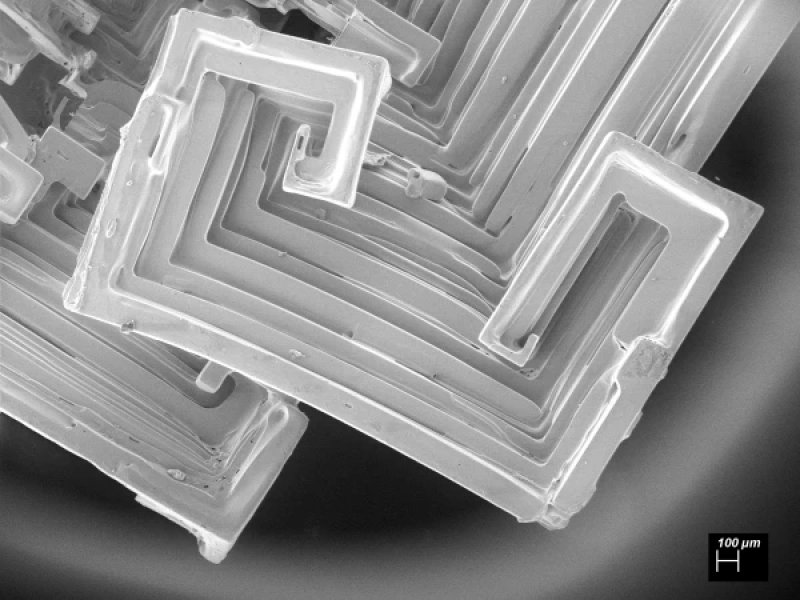
NASA astronaut Don Pettit shared a photograph of a potassium chloride crystal grown aboard the International Space Station. Under the microscope, it resembles a miniature futuristic sculpture rather than a typical salt crystal, writes [Live Science](https://www.livescience.com/chemistry/nasa-astronaut-shares-image-of-impossible-looking-hopper-crystal-growing-on-the-space-station-what-is-happening). The image was published on July 18 along with a video recording of the crystal growth process in microgravity. Scanning electron microscope look at the hopper crystals I grew on ISS. These are potassium chloride crystals exhibiting a relatively rare "scroll" morphology with step-like structures under weightless conditions. https://t.co/1yVkiH63UC pic.twitter.com/P01hPKBkSR— Don Pettit (@astro_Pettit) July 18, 2026 Despite common belief, gravity does not completely disappear on the ISS. However, its influence is about a million times weaker than on the surface of the Earth. This is why familiar processes begin to occur quite differently. As explained by Ann Wilson, a professor of chemistry and biochemistry at Butler University, in such conditions, molecular attraction and other interatomic interactions begin to play a more significant role than gravity. On Earth, growing crystals eventually become heavy enough to settle, deform, or break under their own weight. In orbit, this does not happen, allowing them to grow freely in multiple directions. Potassium chloride typically forms cubic-shaped crystals. However, in microgravity, growth predominantly occurs along the edges and corners, leaving the center hollow and giving the crystal a complex stepped pyramidal shape. This formation method is referred to by scientists as "hopper growth." As new facets appear, the direction of growth can change, creating astonishing spiral structures. This is why the published image looks so unusual that many believe it to be artificially created. However, the significance of the experiment goes far beyond a beautiful photograph. Materials grown in space typically contain fewer structural defects than similar samples obtained on Earth. This allows scientists to better study the properties of crystals and apply the knowledge gained in the development of semiconductors, optical materials, and other high-tech products. According to Ann Wilson, such experiments not only aid science but also spark interest among the general public. "Who would have thought that such a simple thing as potassium chloride could be so impressive?" the researcher noted. Crystal research is just one of many scientific programs on the International Space Station. Recently, astronauts conducted experiments with Bose-Einstein condensate, and earlier, scientists found that moss spores that spent nine months in outer space continued to grow after returning to Earth.
