

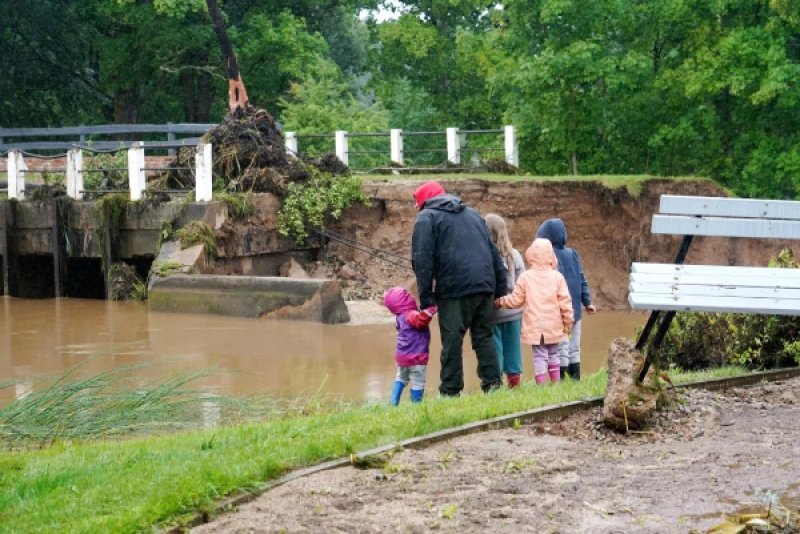
On Thursday, about 30 volunteers went out to clean the area in the village of Dursupe in the Talsi region to help eliminate the consequences of the massive flooding. For now, they are only allowed to clear trees, shrubs, and debris brought by the water — the main restoration work will begin after the inspection of the damaged facilities is completed, writes Latvijas Avīze. According to the head of the combined administration of the Lauciene municipality, Juris Kronbergs, on the night of Monday, around 120 liters of precipitation per square meter fell in the Dursupe area in just a few hours. This was enough for the small Dursupe River to literally change its course. Initially, the powerful flow destroyed the culvert under the road, then breached several dikes, and ultimately damaged the dam of the mill pond. One of the floating islands swept away the sluices; however, as Kronbergs noted, even without this, the hydraulic structure would hardly have withstood such a load. According to preliminary data, municipal roads have been damaged in 53 locations. Their restoration is estimated at about 600,000 euros, but this amount is not final. This means that the scale of the damage continues to grow. Water is still flowing from the forests and drainage systems, and during the assessment of the consequences, heavy rain began again in the region. The problems have affected not only the road infrastructure. Over two days, Talsi received 77 requests to pump out wastewater, with the volume of incoming sewage increasing by about six times. The municipality is also preparing to pay crisis benefits to residents whose property has been affected by flooding. According to preliminary estimates, there will be at least twenty such payments. The disaster has also impacted municipal institutions. Three buildings have been damaged, including the Talsi Museum, where water flooded the archival written collections. Efforts are currently being made to preserve the documents with the help of staff from other museums and neighboring municipalities. The executive director of the Talsi municipal government, Marika Grohjacska, believes that the total damage has already reached about one million euros. However, final calculations are still ahead. Despite the scale of the destruction, a state of emergency will not be declared in the Talsi region. This decision was made at an extraordinary meeting of the Saeima's commission on state administration and municipal affairs. The Ministry of Smart Governance and Regional Development explained that current legislation already allows for the acceleration of road restoration — necessary procurements can be conducted through a negotiation procedure without the standard lengthy competitions. Now the main task will be to restore the damaged infrastructure and assess the full extent of the damage, as the consequences of the bad weather continue to manifest even days after the rains.