

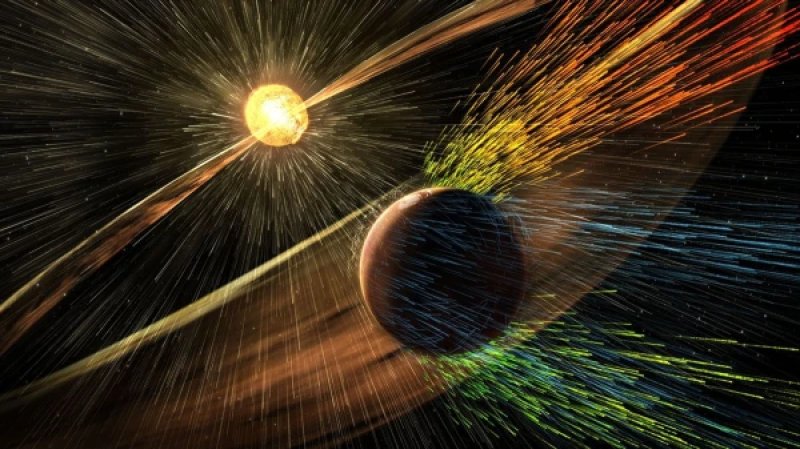
Scientists working with data from NASA's MAVEN (Mars Atmosphere and Volatile Evolution) mission have made an important discovery that helps explain the origin of some auroras on Mars. The results of the study were published in the journal Nature Communications. Researchers found that a process very similar to the so-called Dungey cycle occurs over certain areas of the Martian surface — a mechanism responsible for the occurrence of auroras on Earth. On our planet, the magnetic field forms a giant protective "bubble" — the magnetosphere. When the solar magnetic field interacts with it, energy is redistributed, charged particles are accelerated, and then they collide with the atmosphere, creating bright auroras. For a long time, it was believed that this process was impossible on Mars, as the Red Planet lacks a global magnetic field. However, Mars has preserved small areas of ancient magnetized crust about 4 billion years old. It is above these areas that scientists discovered a diminished version of the Earth's aurora formation mechanism. "We knew that magnetic reconnection occurs on Mars, but we did not expect it to be so similar to the Dungey cycle," noted lead author of the study Shaosui Xu from the University of California, Berkeley. Data collected by the MAVEN spacecraft played a key role in the discovery. Several scientific instruments on the station were used to measure magnetic fields, plasma flows, and the movement of charged particles in the Martian atmosphere. Interestingly, the discovery itself was made after the mission had concluded. Contact with the MAVEN spacecraft was lost on December 6, 2025, and on June 3, 2026, NASA officially declared the spacecraft irretrievable and ended the mission. Nevertheless, the data accumulated over the years continue to be used for new research. According to scientists, the discovery helps to understand not only the nature of Martian auroras but also why Mars and Earth, formed under similar conditions, ultimately evolved in completely different ways. "This discovery changes our understanding of auroras on Mars and helps better understand the evolution of the Red Planet," said MAVEN mission leader Shannon Curry. Researchers note that understanding the interaction of solar wind with the Martian atmosphere will be particularly important in preparing for future robotic and crewed expeditions to the Red Planet.
