

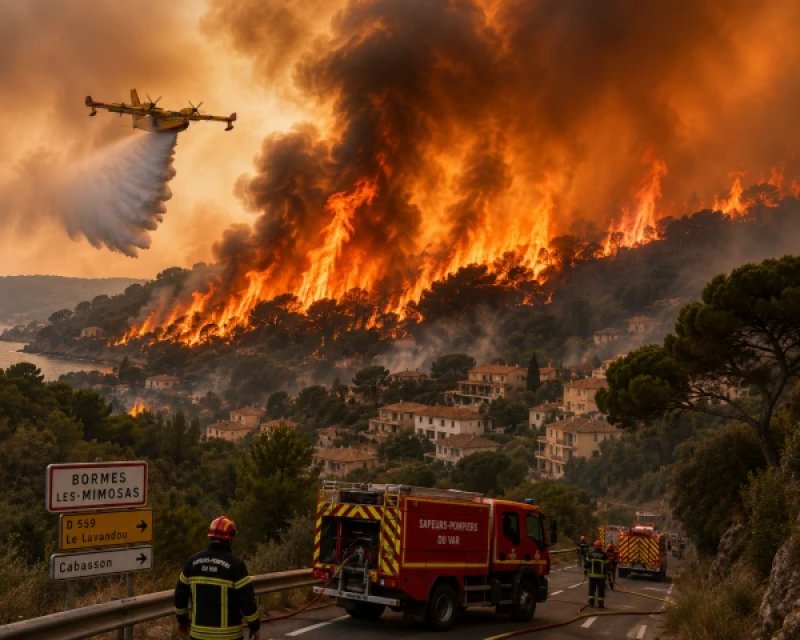
Emergency services in France and Spain remain on high alert to combat the most destructive wildfires in decades, ignited by a new wave of heat in southwestern Europe. French President Emmanuel Macron announced on Monday, July 27, that the blaze in the southwest of the country is "under control." Meanwhile, near Bordeaux, the fire has not yet been contained. The French leader visited the crisis center of emergency response services. "The coming weeks will be tough," Macron was quoted by AFP. According to the politician, these are the strongest wildfires in France since the end of World War II. The disaster in the region between Bordeaux and the Atlantic coast has devastated an area of about 42,000 hectares since July 22. On Monday, the flames continued to spread, with 220,000 people evacuated to safety. Wildfires across the country have already destroyed 116,000 hectares this year. ## ## "Fire clouds" recorded in France Meanwhile, in southwestern France, according to AFP, thunderstorm "fire clouds" (pyrocumulonimbus) have been recorded for the first time in history. The ground air is heated so intensely that it rapidly rises along with smoke, water vapor, and ash, often to great heights - even up to the stratosphere. When colliding with cooler air masses, strong winds are formed, which further fan the flames. Often, these clouds generate lightning. Such phenomena have been observed during massive wildfires in Australia and Canada. For France, it is "unprecedented," said fire service representative Eric Brocardi. According to him, firestorms are almost impossible to extinguish or control in most cases, partly because the wind constantly changes direction. "As a result, it spreads in all directions and creates multiple fire fronts, making the situation completely unpredictable," the expert explained. ## ## EU supports France and Spain As part of the EU mechanism for disaster relief, European countries, as well as Brussels, are providing France and Spain with 13 planes, 4 helicopters, 41 vehicles, and sending about 130 rescuers, the European Commission reported. Germany is also involved in the operation. Both countries are also receiving satellite images under the EU's Earth observation program - Copernicus - to assist in firefighting efforts. The total number of evacuees in the two countries has exceeded 300,000 - one of the largest evacuations in European history, noted KNA. Ten countries, including Turkey, Norway, and Ukraine, are connected to the EU mechanism. The European Commission coordinates aid proposals and participates in funding operations. The European Union can also deploy 22 planes and 5 helicopters from the strategic reserve rescEU.
