

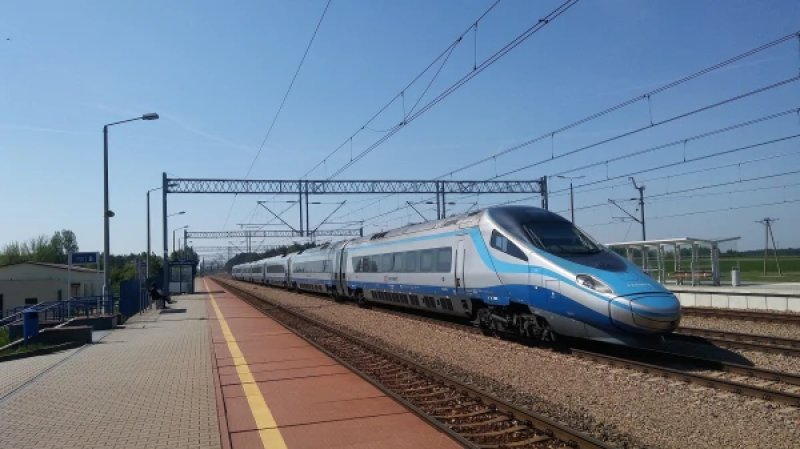
Poland is embarking on the largest transport project in its history — the Integrated Railway Network (ZSK). The program was announced by Prime Minister Donald Tusk, Infrastructure Minister Dariusz Klimczak, and his deputy Piotr Malepszak at a press conference in Warsaw. About **610 billion zlotys** is planned to be allocated for the construction of a modern railway system. Authorities aim to transform the railway into the fastest, most convenient, and popular mode of transport in the country. The project includes the construction of **4,700 kilometers of new tracks**, of which **2,700 kilometers** will be high-speed lines. Trains will be able to reach speeds of up to **350 km/h** on these lines. Another **2,000 kilometers** will consist of conventional railway lines, and **5,600 kilometers** of existing infrastructure will be completely modernized. A key feature of the project will be the concept of **“Poland in 100 Minutes.”** Thanks to the new network, the journey from Warsaw to the largest cities in the country will take about one and a half hours, and crossing Poland from north to south or from west to east will take a maximum of three hours. The new network will cover all **314 counties** and **66 cities** that have county status. According to the authorities, this will help eliminate the transport isolation of many regions and serve as a stimulus for the economic and social development of the country. It is expected that after the project is completed, approximately **800 million passengers** will use the railways annually. In comparison, in 2025, Polish railways transported over **438 million people**, which was a record figure for the last three decades. The growing popularity of trains is expected to be supported not only by the new highways but also by the digitalization of the railway system, the creation of convenient parking at stations, and the introduction of a unified schedule with regular train intervals. Initial works have already begun. Tenders have been announced for the construction of the first 13-kilometer section of the high-speed line near Warsaw, and global manufacturers Alstom, Talgo, Siemens, and the Hitachi Rail consortium with the Polish company Pesa are competing for the right to supply 20 high-speed trains. The first phase of the project — the high-speed line connecting Warsaw, Łódź, Poznań, and Wrocław — is planned to be completed by **2035**. The complete construction of the Integrated Railway Network is expected to be finished between **2050 and 2060**. If the project is fully realized, Poland will have one of the most modern and extensive railway systems in Europe, and travel between the largest cities in the country will become significantly faster and more convenient.