

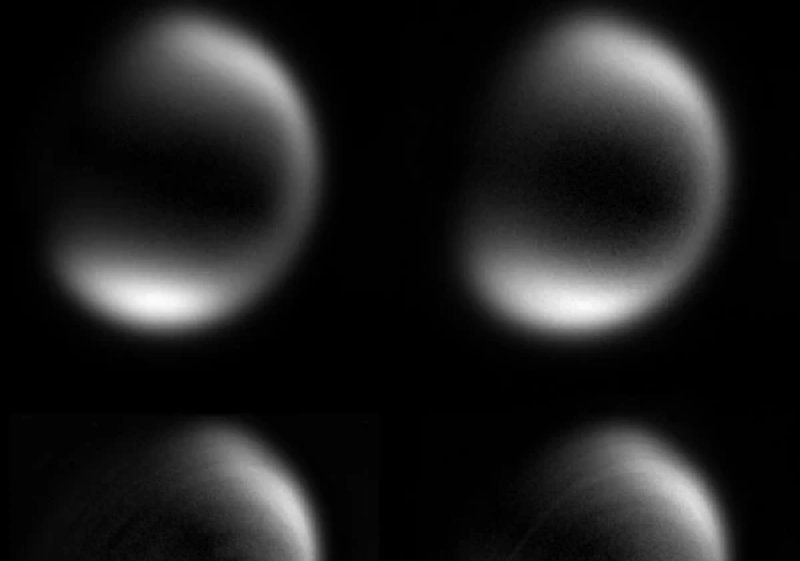
Unusual structures were first recorded back in 2010 during a chance 36-minute observation of Venus using the experimental polarimeter ExPo, mounted on the William Herschel Telescope in the Canary Islands. The instrument registered polarized light, allowing it to detect atmospheric features invisible to ordinary telescopes. Researchers saw huge concentric rings encompassing much of the daylight side of Venus. Initially, scientists suggested it was an equipment error; however, numerous checks did not confirm this version. As the lead author of the study, atmospheric physicist Gourav Mahapatra from Delft University of Technology, explained, the team struggled for a long time to find an explanation for the observed signal and only then decided to publish the results, detailing their limitations. Later, scientists compared old observations with data from the Japanese spacecraft Akatsuki, which detected giant atmospheric waves in Venus's atmosphere spreading almost across the entire planet. Following this, researchers built a computer model to test whether such waves could create the observed effect. The modeling showed that small changes in atmospheric density — just 5–10% — could indeed form polarization rings similar to those recorded during the observations. So far, scientists do not claim that the rings actually exist. They have only been seen once, so new observations using modern polarimeters are necessary. If the existence of these structures is confirmed, they will help better understand processes in Venus's atmosphere. Of particular interest is the phenomenon of so-called super-rotation — when the dense atmosphere makes a complete rotation around the planet in about four Earth days, while Venus itself rotates on its axis extremely slowly, completing one rotation in 243 Earth days. Researchers believe that giant atmospheric waves may transfer energy between different layers of the atmosphere and play a crucial role in maintaining this unusual circulation pattern. According to the authors of the study, exploring Venus is important not only for understanding the planet itself. Despite the extreme conditions — temperature, dense atmosphere, and clouds of sulfuric acid — the physical processes occurring in planetary atmospheres obey the same laws. Therefore, new data help refine models used in studying Earth's atmosphere as well. The results of the study are published in the journal [The Planetary Science Journal](https://iopscience.iop.org/article/10.3847/PSJ/ae7e6f). Even if the mysterious rings turn out to be just a rare atmospheric effect, they could open up a new way for scientists to study one of the most unusual planets in the Solar System.
