

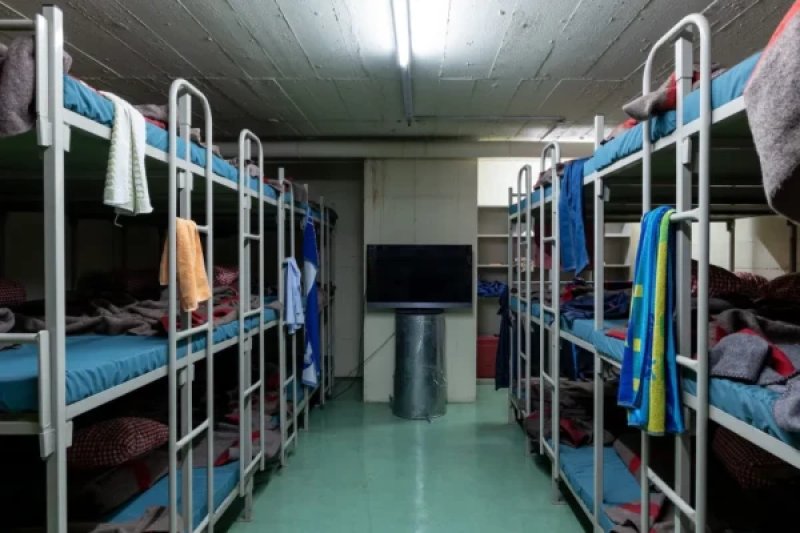
Following the off-site government meeting at the military base in Luznava (which cost taxpayers a pretty penny) and Prime Minister Andris Kulbergs' statements about the need to protect energy networks from Russian attacks, there are now attempts to hide as deep as possible! "On proposals for simplifying and accelerating the procedures for building shelters and adapting buildings for shelter needs," is the title of a document recently released by the Ministry of the Interior of Latvia. In the matter of bunkerizing the country, it is also supported by agencies that, at first glance, are purely civilian – the Ministry of Smart Administration and Regional Development, and the Ministry of Economics. Local governments are also involved. ## Choose a basement by level The population of the republic is offered to take shelter in various types of bunkers in case of emergencies: "1) Shelter Category I – the highest protection requirements, ensuring protection against explosive shock waves, chemical warfare agents, ionizing radiation, and radioactive dust; 2) Shelter Category II – provides protection against the shock wave of an explosion and shrapnel; 3) Shelter Category III – a shelter created by adapting structures or their parts and reducing the impact of the shock wave of an explosion and shrapnel." The first two types of shelters are located in "critical infrastructure facilities of categories A and B, where personnel are expected to be present daily." However, the presence of such institutions and organizations nearby should not tempt one – for example, your author lives near the headquarters of the renowned state concern Latvenergo, but it would never occur to him to rush into the arms of the electric company in case of an emergency. They will be packed themselves. It is slightly more likely to use Category II – public buildings with a total area of at least 2,500 square meters, such as educational institutions. "In other cases, the property owner has the right, according to their needs and capabilities, to create a shelter of any category on their property to provide users of the building with a safe place to find shelter in case of threat." Moreover, the Ministry of Economics has conducted a series of amendments to regulations that facilitate such work. In other words, if you need it – you build it, no one will do it for you. ## Construction regulations First of all, according to the Basic Guidelines on Minimum Requirements for Adapting Premises for the Creation of Category III Shelters (issued by the State Fire and Rescue Department), the following must be done in the designated bunker spaces: - Replace entrance doors, making them from metal, or make them solid wood, clad in metal. - Equip with ventilation – mechanical or natural; - Use appropriate finishing – non-combustible and not producing shrapnel; - Strengthen ceiling supports; - Ensure power supply and lighting, as well as communication lines; - Equip with water supply and sewage. - Build internal partitions to divide the premises. As can be seen, there is a wide range of work ahead – and professionals are indispensable here. "For the adaptation of premises, including the construction of load-bearing walls, the construction of doorways, and other types of openings in load-bearing walls, a construction notification is applied," the document notes from the power agency managed by the National Alliance, "The documentation for the construction project is developed by a construction specialist in the relevant field (architect, structural designer)." "Please note that the construction of internal engineering systems of buildings, if it is highlighted as a separate project, is carried out in accordance with the requirements of the Cabinet of Ministers regulations of May 9, 2017, No. 253 'Construction Rules for Individual Engineering Structures.' Stop, wait a minute – but these are peacetime rules, written five years before the start of large-scale hostilities in Eastern Europe. What is the point of such bureaucracy now? ## Get it done by 2030 However, if we believe the local authorities, we still have about 3.5 years left. Because the deadline for the construction of shelters is set for December 31, 2029; by this time, it is planned to "adapt and equip at least 500 facilities for the needs of civil defense in Latvia." For this noble cause, at least €25,113,520 is allocated, of which €22,196,492 is funded by the European Regional Development Fund, and €3,917,028 comes from state and municipal budgets. The figures, at first glance, seem substantial – however, upon closer inspection, we get just over €50,000 per facility. Not that generous. And considering the continuously rising prices for building materials and the appetites of workers involved in the process, one can imagine that in the coming years, the estimates will swell even more... Here is a very telling table on the status of potential civil defense facilities as of July 6, 2026: there are 560, contracts signed – 64, built – 1! The happy pioneer was the psychiatric hospital "Gintermuiža" (Jelgava), which spent €37,063 on the shelter. In general, it is noteworthy that some administrative units of the republic have not even bothered to designate places for bunker construction. In particular, the most carefree was the Ventspils region, where they apparently live under the illusion that a potential adversary would not strike there. Although this territory borders directly on the Baltic Sea – which means enemy landings are possible! ## A standard shelter is needed In fact, the Ministry of the Interior realizes that the program for converting basements into shelters may not succeed: "Given the nature of construction in Latvia, it may happen that the existing premises in buildings that meet the established guidelines are insufficient to provide all users of the building with a safe opportunity for shelter, or such premises do not exist. The reconstruction of other premises may be technically impossible or very complicated and would require disproportionately large financial resources. In this case, it is worth considering the construction of a standalone shelter." Such underground shelters, of a modular type, are already being produced factory-style, according to NATO's unified standards. And the Ministry of the Interior is ready to install them here too – they just need another €10 million!  _Infographic tapportals.mk.gov.lv_