

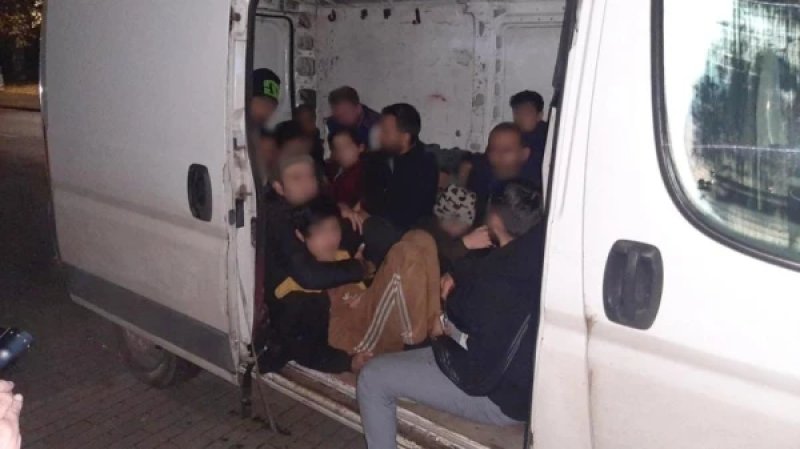
According to the Director General of the Police and Border Guard Board (PPA) Egert Belichev, as of Wednesday morning, 102 illegal migrants had been detained in the country this year, 63 of whom were detained in the last week. For comparison, he cited last year's data, when a total of 39 people were detained in Estonia over the entire year. In the last week, there has not been a day when we did not detain groups or individual illegal border violators. According to Belichev, migrants were detained all over Estonia, but a significant portion was caught in Tallinn or its surroundings. "We detained them in hotels, at the port, in the city center, on the way to the port. We have developed clear risk profiles for police patrols and migration supervision staff, based on which we work and identify illegal immigrants," Belichev said. He added that the PPA is also closely cooperating with the Finnish police and border guard in case someone manages to slip through Estonia. In such a situation, they can be quickly detained on the Finnish side. Estonia has previously sent its police units to assist Latvia at the border with Belarus to combat illegal immigration. Soon, another police unit from Estonia will be sent to assist their Latvian colleagues as part of the Estpol mission. ## ## This is an obvious migration attack According to Interior Minister Igor Taro (Eesti 200), who returned from Lithuania on Wednesday night, it can be said with complete confidence that the Belarusian regime is deliberately directing migrants to the European Union border. "Knowing how things are in the border zone in Russia and Belarus, one can say with a high degree of certainty that no one can just end up in the border zone in these countries. There is strict control for many kilometers before the border. In Belarus, state structures are definitely involved in this," Taro said. He added that there is video evidence of alleged Belarusian border guards directing migrants to the border and sometimes even helping them break through border barriers. They remain on the other side of the fence and push people through the fence or through holes made in it. "If you look at what tools migrants carry with them, it becomes clear that no one sets off on a journey with a long ladder, large pliers, or an electric grinder. Border guards in both Lithuania and Latvia have confiscated such items," said the Interior Minister. According to Taro, the new approach of the Belarusian regime in directing migrants to Lithuania involves the construction of tunnels, which shows that when border infrastructure is well built, smugglers adapt to the situation. The minister noted that the tunnels use solid and well-thought-out engineering solutions, for example, a large amount of wood is used for their reinforcement. "It is obvious that people arriving from Afghanistan or Somalia cannot build such tunnels on their own. That is why I say this is a hybrid attack; all the circumstances are crystal clear. This is not some random movement of people," the minister stated. According to Taro, Estonia's goal is to cut off the routes of migrant movement and make it clear to illegal border violators that heading towards Estonia is pointless and that their journey will end where it began. In the minister's opinion, from Estonia's perspective, closing the internal borders of the Schengen zone does not make much sense, as the experience of southern countries has shown that in such cases, migrants simply change routes, and the problem is essentially not solved. He believes that it is necessary to focus on the root cause, that is, on the external border. ## ## Latvia will accept back migrants detained in Estonia Taro added that illegal border violators detained in Estonia will not become a burden for the country, as Latvia will accept back all detainees known to have entered the European Union through the Belarusian-Latvian border. According to Belichev, the people detained in Estonia are currently placed in a detention center, where the necessary procedural actions are being carried out with them. "We have received confirmation from Latvia that it will accept back all illegal immigrants who arrived through its territory. Cooperation with the Latvians is very well established," the police chief confirmed. Belichev noted that the arrival of such a large number of foreigners who illegally entered the country creates a significant procedural burden not only for the Police and Border Guard Board but also for many other state agencies and institutions. "Detaining such a number of people significantly affects judicial proceedings, as a court order is required for detention. This also affects the availability of interpreters. Moreover, it creates a burden on local governments, as among the arrivals are individuals claiming to be minors. This means that in their case, the local government must act as a guardian to carry out the necessary procedures," the police chief explained. Belichev emphasized that this is a nationwide operation, and for this case, the relevant agencies have been developing crisis plans for years to counter the increased flow of illegal immigrants. Belichev acknowledged that the forecast for the near future is not optimistic, and apparently, the migratory pressure on the Latvian border from Belarus will continue for several more months. "Today, it can be predicted that the pressure will remain at least until favorable weather conditions exist, that is, definitely until the end of summer and the beginning of autumn. When the weather deteriorates in late October or November, the pressure will ease. This means that we in Estonia must also be prepared for the fact that illegal migrants will continue to arrive. We must continue to detain them, cut off their path, and thereby send a signal to the adversary that it is not so easy to influence us and break us," the police chief said. According to Taro, what is happening now in Latvia clearly shows how important it is to build reliable border infrastructure. In his opinion, this indicates that Estonia is on the right track by investing significant resources in border arrangements. The minister noted that the biggest difference between Latvia and Lithuania is that Lithuania's border infrastructure is at the same level as Estonia's, and they are not currently experiencing such strong migratory pressure. "Of course, we also have something to think about. In building border infrastructure, we proceeded from the fact that in some very marshy areas, it may not make sense to plan barriers. Perhaps these areas will need to be reconsidered in terms of installing additional barriers there," Taro said.