

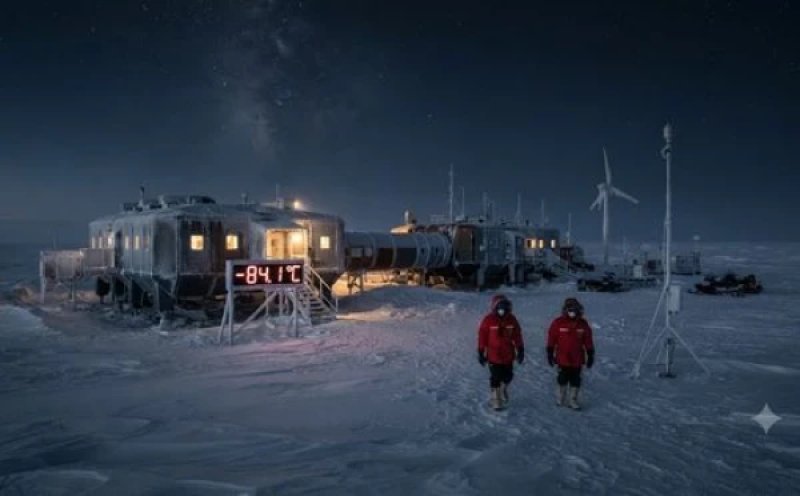
The station is located deep in East Antarctica at an altitude of over 3200 meters above sea level and more than 1000 kilometers from the coast. At this time of year, the region experiences polar night, when the sun does not appear for several months, and temperatures regularly drop below -80 °C. The head of the station, Gabriele Carugati, explained that such readings are the result of a combination of high altitude, extremely dry air, and the absence of clouds, which facilitates intense heat radiation into space. The recorded cold sharply contrasts with the abnormal heat observed this summer in North America and Europe. Nevertheless, scientists emphasize that local extreme readings do not contradict the trend of global warming. Climate change is characterized by a long-term increase in average temperatures across the planet, while specific atmospheric processes can periodically lead to record frosts in certain areas. "Concordia" is considered one of the most inaccessible research bases in the world, situated on an ice sheet about 3300 meters thick. During the winter period, the station is completely cut off from the outside world: planes cannot operate flights, and the nearest research base is about 600 kilometers away. The isolation conditions here are so harsh that the work of researchers is often compared to space missions, and the scientists themselves are referred to as "ice astronauts." Despite the significance of the current reading, it is not an absolute record. In the winter of 2010, this same station recorded a temperature of -84.7 °C, and the historical maximum frost for the Earth was registered at the Russian station "Vostok" in 1983, where thermometers showed -89.2 °C. According to satellite observations, in certain areas of East Antarctica, the surface can cool to -98 °C. The obtained data will allow specialists to fine-tune climate models for predicting future changes in the state of the planet's atmosphere.
