

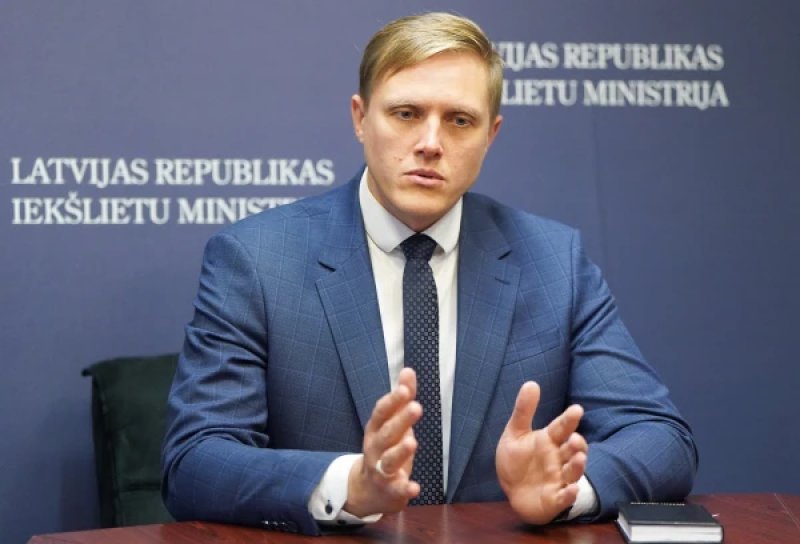
The Ministry of the Interior of Latvia has sent an informational report on measures to limit immigration, including the introduction of quotas for citizens of third countries, for approval to other ministries. The document is based on the recommendations of the parliamentary commission investigating the issues of national and European migration regulation, which was previously headed by the current Minister of the Interior, Janis Dombrava (National Alliance). The commission studied the reasons for the mass entry and stay of citizens of third countries in Latvia, as well as the work of state authorities in this area. The draft government decision provides for support for the proposed measures. All responsible institutions will have to report to the Ministry of the Interior on the progress of their implementation by October 2027, and the ministry itself will present a final report to the government by December 2027. The plan includes measures in 11 areas. One of the proposals is to amend the Criminal Code to establish criminal liability for knowingly providing physical or informational support to a foreign state or actions in its interests if they are related to the use of migration as a tool of hybrid threat against Latvia. It is also proposed to assess the possibility of concluding legal assistance agreements with countries from which the largest number of migrants arrive and with citizens of which there are increased risks of using forged documents. In addition, the Ministry of the Interior proposes to consider limiting the issuance of visas to citizens of those third countries with which Latvia has no agreements on legal cooperation, migration management, or readmission. Regarding asylum seekers, it is proposed to require them to register regularly if they live outside accommodation centers. Sanctions are planned for violations of this requirement. In the case of voluntary disappearance, it is proposed to annul the asylum application and deport the person from the country. The plan provides for the introduction of additional security checks at Riga Airport, as well as for international passenger road, rail, and sea carriers. It is proposed to check whether tickets issued in the name of another person are being used by mandatory matching of the ticket with an identity document. A significant portion of the proposals concerns foreign students. It is planned to revise the strategy for exporting Latvian higher education in light of national security interests. It is proposed to identify priority countries for attracting students, establish stricter admission criteria, enhance monitoring of the education of students from third countries, and track their further activities after graduating from Latvian universities. It is also proposed to amend the Law on Higher Education, requiring foreign students to attend at least 70% of classes. Students who miss more than three days without a valid reason during the academic year are proposed to be expelled. At the same time, the Ministry of the Interior proposes to limit the share of foreign students in Latvian universities. This should not exceed 50% of the total number of students. In addition, it is planned to establish separate restrictions on the share of students from third countries among all foreign students. It is proposed to change the admission rules, establishing that applicants from third countries must not have a grade lower than eight points in any school subject before enrolling in a Latvian university. The report also provides for the possibility of revoking the accreditation of an educational institution for serious or systematic violations related to the admission of foreign students and compliance with the conditions of their stay in Latvia. For foreign workers, it is proposed to create a timekeeping system, within which both the employer and the worker will be required to register the actual hours worked. In addition, it is proposed to amend the Immigration Law, establishing that only the enterprise where they will actually work can invite citizens of third countries for employment. At the same time, it is planned to create a mechanism for enhanced control over companies providing services for attracting foreign labor. Another initiative concerns drivers from third countries. It is proposed to amend the Road Traffic Law, requiring such drivers to obtain European Union driving licenses if driving is part of their job responsibilities in a company registered in the EU. At the same time, it is proposed to implement a mechanism for verifying actual driving skills regardless of the presence of a national driving license obtained outside the EU. For students working through digital platforms, as well as in the courier delivery sector, it is planned to develop regulations requiring platform companies to conduct biometric identification of the performer before each start of work. This measure is intended to prevent fraud and illegal employment. At the same time, it is proposed to establish effective mechanisms for control and accountability for non-compliance with these requirements. Since, according to the Ministry of the Interior, the capabilities of state institutions have already reached their limit at the current level of immigration, the ministry proposes to introduce quotas on the total number of citizens of third countries who will be able to obtain residence permits or long-term visas. To this end, it is planned to develop and approve a Cabinet of Ministers regulation that will determine the maximum allowable number of citizens of third countries entitled to enter and reside in Latvia. It is expected that the corresponding decision will be made in the first quarter of 2027. In an interview with the LETA agency, Minister of the Interior Janis Dombrava stated that the strictest quotas may be introduced for citizens of so-called terrorist risk countries. At the same time, the minister did not specify a concrete list of states for which the restrictions will be more or less strict. "Restrictions will apply to everyone who is not a citizen of European Union countries. There will likely be exceptions for citizens of European Economic Area countries, NATO states, and discussions continue regarding citizens of countries of the Organisation for Economic Co-operation and Development (OECD). As for citizens of Sri Lanka, India, Uzbekistan, Tajikistan, and many other countries, these measures will primarily apply to them," Dombrava stated.