

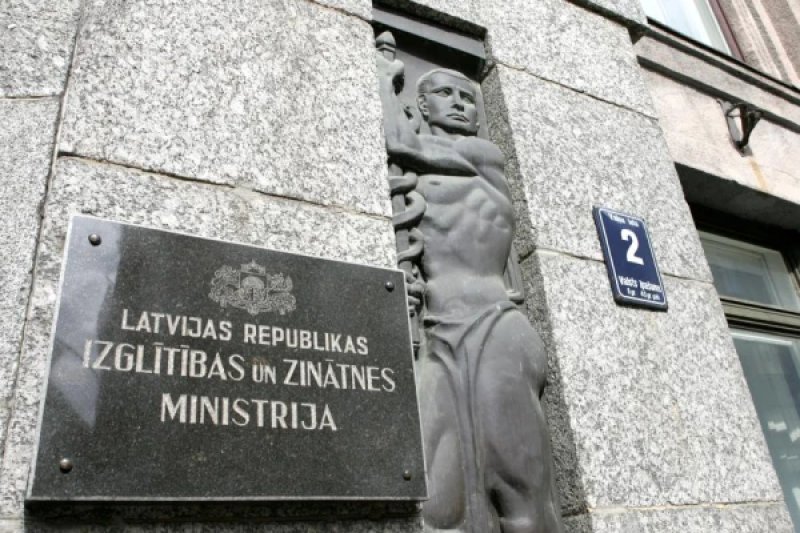
At the end of July, the Ministry of Education and Science (MoES) announced a competition, the results of which will allow sports federations to receive state co-financing for hosting world and European championships in 2026. However, the conditions of the competition raised questions among industry representatives, primarily due to the five-day deadline for submitting applications, [public media reports](https://www.lsm.lv/raksts/sports/sporta-politika/03.08.2026-finansejumam-starptautisku-cempionatu-rikosanai-japiesakas-5-dienas-ministrija-konkurss-skiet-atbilstoss.a657223/). An additional requirement was the presence of a conclusion from the National Sports Council, which, according to critics, is practically impossible to obtain in such a short time unless the federation had prepared in advance for participation. The ministry rejects these claims. Alexander Samoilov, the Director of the Sports Department of MoES, stated that the competition was not a surprise for the sports community. > "All federations already knew whether they planned to host the European or world championship. Since the competition concerns events in 2026, we believed that a longer application period was unnecessary," said Samoilov. According to him, the program was designed not for those who decided to organize an international tournament only after the announcement of the competition, but for federations that were already preparing such events. At the same time, Samoilov acknowledged that preparing an application for hosting a European or world championship in just five days is impossible. > "That is why we were talking about events in 2026. The competition was intended for those federations that were already planning to host European and world championships," he explained. A total of 225 thousand euros has been allocated for the program. The funds are provided as part of additional financing obtained with the participation of the Ministry of Economics. One of the main conditions of the competition is that the supported competitions must bring at least 500 thousand euros to the Latvian economy, meaning they must provide an effect at least twice the amount of state funding. According to Samoilov, the program was created as a support tool not only for the largest international tournaments. > "We tried to create a program that would allow support for other international competitions, especially smaller-scale ones. This is particularly relevant for the regions," he noted. A total of eight applications were submitted for the competition. Among the candidates is the World Bridge Championship, a project promoted by National Alliance politician Imants Parādnieks. Critics of the competition believe that the five-day application deadline may contradict the principles of good governance and proportionality enshrined in the legislation. Additionally, questions are raised about whether the ministry has the right to independently establish the procedure for distributing such funding. Samoilov stated that the competition regulations underwent legal review within the ministry. > "The competition regulations also underwent legal expertise to ensure compliance with the requirements," he said. According to him, it was initially planned for the Council of Sports Federations of Latvia to conduct the competition, but the legal department of MoES concluded that the organizer should indeed be the ministry. The legality of the competition procedures has already been the subject of judicial proceedings for MoES. Earlier this year, the ministry lost a case to the Latvian Volleyball Federation related to the distribution of state sports funding. Despite the criticism of the competition conditions, MoES considers the procedure legal and compliant with the requirements. An administrative court may assess these arguments if necessary.