

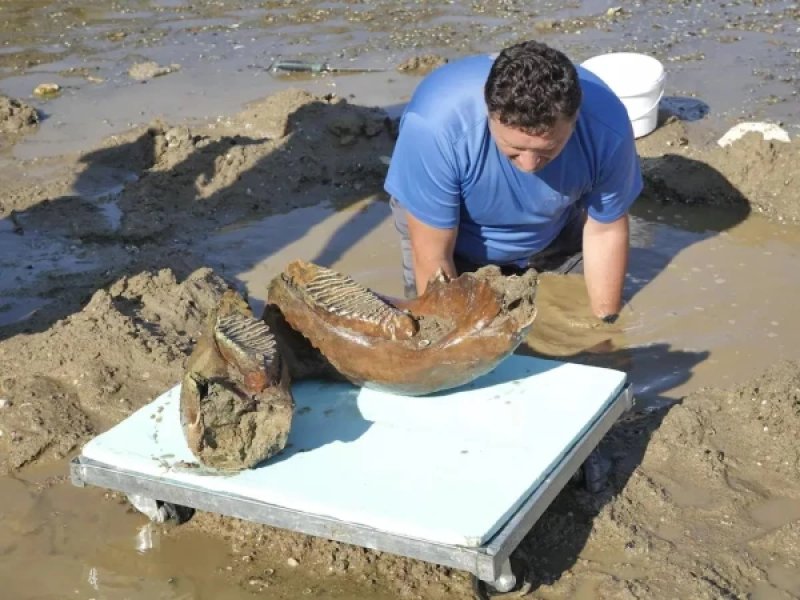
A record drought and abnormal heat in Europe have led to a sharp drop in the water level of the Danube. As a result, dozens of sunken ships from World War II have emerged from the water, including German military vessels, as well as remains of woolly mammoths that have lain on the riverbed for thousands of years, reports the New York Post. According to CBS, the water level in the Danube has fallen to record lows, revealing unusual historical finds. Among them are at least 20 German military ships, some of which still retain armaments that belonged to the Black Sea Fleet of Nazi Germany.  Particular attention is drawn to one of the ships near the Serbian port of Prahovo. Its rusted hull and broken mast, which once flew the Nazi flag, have become a local attraction and draw many curious visitors.  These vessels were sunk by the German troops themselves in September 1944 in the Danube Gorge as they retreated under the pressure of the Red Army. Estimates suggest that up to 200 ships were sunk at that time. After the war, the authorities of socialist Yugoslavia raised some of the ships, but most remained on the bottom. The reason was the explosives and ammunition on board, which make recovery operations dangerous even decades later. Due to the sharp drop in water levels, authorities are now forced to take measures to ensure navigation on the section of the Danube that separates Serbia and Romania. > "As you can see, large vessels can no longer pass here," said local resident Krista Brandic. Unusual finds have appeared not only in Serbia. In Bulgaria, near the city of Ruse, a jawbone and fragments of a woolly mammoth tusk were discovered on the exposed riverbed. According to Nikolai Nenov, director of the Regional Historical Museum, the found remains "most likely" belong to a mammoth that lived during the Ice Age. The Danube is the second longest river in Europe, flowing through ten countries. In the capital of Hungary, Budapest, the water level fell to just 10 centimeters at the beginning of the week, while the previous record low, recorded in 2018, was 33 centimeters.  Experts note that the extreme shallowing is already seriously complicating navigation and will likely lead to new archaeological discoveries. However, scientists remind us that such finds are a consequence of the abnormal heat and drought that are increasingly affecting the largest rivers in Europe.
