

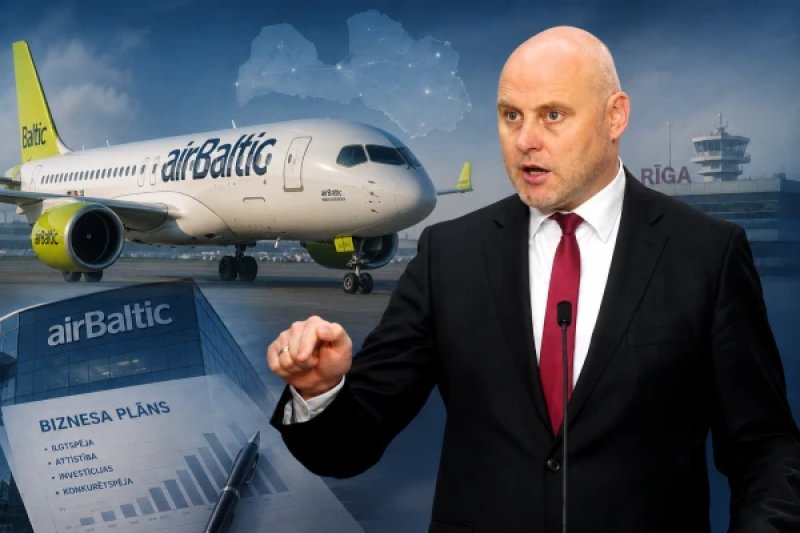
Prime Minister Andris Kulbergs believes that the new business plan for airBaltic is a necessary step to pull the national airline out of a difficult financial situation. However, he stated that merely approving the document is not enough — it now needs to convince creditors, potential investors, and the government. Speaking at a government meeting, the head of the Cabinet emphasized that the situation at airBaltic remains very serious and the authorities intend to speak openly about it with the public. According to Kulbergs, the airline has entered a decisive phase in its development. Several factors will influence the future fate of the carrier: the company's financial position, assessments from international rating agencies, negotiations with bondholders, and the need to attract €225 million in temporary financing. The Prime Minister noted that the question is no longer whether airBaltic needs significant changes, but how quickly they can be implemented. He emphasized the strategic importance of the airline for Latvia — in terms of international air connectivity, the development of Riga Airport, tourism, and attracting investments. At the same time, Kulbergs made it clear that the strategic importance of the carrier does not mean automatic government support. If the company requires additional capital, the solution must involve private investors, creditors, and a full restructuring of the business. In fact, the government expects that the responsibility for the financial recovery of airBaltic will be shared between the state and the private sector, rather than falling entirely on taxpayers. The Prime Minister also criticized the decisions of previous authorities, stating that the current problems of the company are a result of mistakes made in the past years. According to him, it was then that the foundation for the current crisis was laid. "The problematic situation was 'concreted' during the previous government when the incompetence of the then Minister of Transport reached its peak," the Prime Minister stated. In the coming weeks, the head of government believes it will become clear whether creditors are willing to support the proposed scheme, whether the necessary temporary financing can be attracted, and whether the updated business plan can interest strategic investors. Transport Minister Richard Kozlovskis has been tasked with continuing negotiations with creditors together with the board and management of airBaltic, as well as international consultants, to seek a new strategic investor. One of the key stages will be a re-vote by bondholders. The results of this vote will largely determine the future financial model of the company. If additional state funding is subsequently required, which would need parliamentary approval, the final decision will be made by the Saeima. This week, the updated business plan for airBaltic will be presented to the parliamentary budget committee. It is worth noting that the business plan approved by the company’s board provides for attracting €225 million in temporary financing, reducing the planned fleet from about 100 to 40 aircraft by 2031, and shifting to a strategy focused primarily on financial stability rather than rapid growth. Meanwhile, the international rating agency Standard & Poor's has downgraded airBaltic's credit rating by two notches — from CCC+ to CCC-. The agency [believes](https://bb.lv/statja/ekonomika/2026/08/11/airbaltic-utverdil-novyi-biznes-plan-kakie-peremeny-zdut-kompaniiu-i-passazirov) that in the coming weeks the rating could be lowered to a default level if the airline does not reach an agreement with bondholders and does not secure the necessary financing.
