

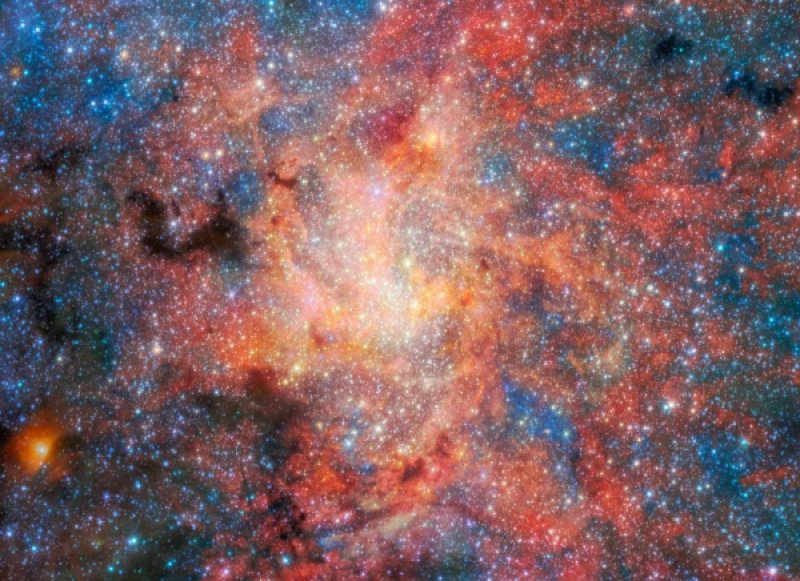
The James Webb Space Telescope has helped an international team of scientists make an unexpected discovery in the center of the Milky Way. Observations have shown that water and cosmic dust continue to form and persist just 0.55 light-years from the supermassive black hole Sagittarius A*. This concerns the star IRS 3, which is in one of the final stages of its life. Typically, such stars lose a tremendous amount of material, ejecting it into the surrounding space. Until now, scientists have doubted that this process could occur so close to a black hole, where extreme radiation prevails. New data has shown that these concerns were unfounded. Using the MIRI infrared instrument installed on the James Webb Telescope, researchers have for the first time detected water in the star's shell and determined that it produces oxygen-rich silicate dust. Cosmic dust is considered one of the main 'building materials' for the formation of new stars, planets, and other celestial bodies. "The centers of galaxies are among the most extreme regions of the universe, so the question of whether stars can continue to enrich the surrounding space under such conditions is of great importance. With James Webb, we see that dust formation remains remarkably resilient," noted study leader Florian Peißker from the University of Cologne. Previously, many astronomers assumed that IRS 3 was carbon-rich. However, spectral analysis revealed a completely different picture. The telescope detected characteristic signs of silicate dust composed of silicon and oxygen. This allowed researchers to establish that the star belongs to the oxygen type and continues to actively eject material into space. Equally important was the first confident detection of water in the surrounding star shell. "The detection of water is particularly important as it shows that molecular material can persist even in an environment with extremely intense radiation," emphasized co-author of the study Macarena Garcia Marin from the European Space Agency. Computer modeling has shown that several concentric dust shells surround IRS 3, extending approximately 10,000 astronomical units. The temperature within them gradually decreases—from about 1200 kelvins near the star to around 100 kelvins at the outer boundaries. According to scientists' estimates, the mass of IRS 3 is about six times that of the Sun, and the star is approximately 72 million years old. It is currently undergoing a period of intense mass loss, forming a vast dust shell. The results indicate that even in close proximity to supermassive black holes, processes continue that provide galaxies with material for the emergence of new generations of stars and planets. Previously, such areas were considered too extreme for such processes. The discovery by James Webb expands scientists' understanding of how the centers of galaxies are structured and shows that even near giant black holes, conditions for important cosmic processes are preserved.