

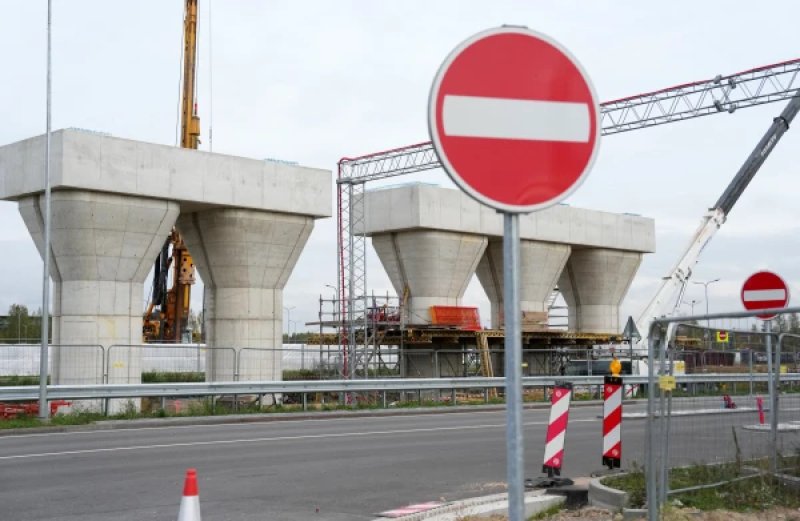
The main route of the "Rail Baltica" railway project at the first stage in Latvia is planned to be constructed in its existing volume, which provides for the creation of a cross-border connection "Rail Baltica" from Lithuania to the border with Estonia, as well as the completion of construction works at Riga Airport and in the southern part of the Riga Central Station to ensure the possibility of connecting "Rail Baltica" with the existing railway network, said Minister of Transport Rihards Kozlovskis ("New Unity") to the media on Wednesday after a meeting of the thematic committee on the implementation of the "Rail Baltica" project. The minister emphasized that this is a decision for the first stage of the project, but the idea of the "Riga Arc" in the project does not disappear. "We would like to look at it differently, but it is 2026, and we need to think rationally," the minister stressed. He reported that on Wednesday the committee heard a report on the results of an in-depth assessment of the "Rail Baltica" project, which summarized three scenarios. "One scenario is to continue as it has been so far, and that is impossible. The second scenario is to reconsider and reduce the requirements, and the third scenario is to immediately halt any further actions," Kozlovskis said. According to him, it is necessary to move towards optimizing the project, that is, to build and finance the technically minimal necessary, rather than "finance various visions and to some extent dreams." Prime Minister Andris Kulbergs stated that Latvia needs a "minimum program," or a basic scenario. During the assessment, consultants concluded that, for example, on the 600-kilometer section of the high-speed train Madrid-Barcelona, there are technically two stations, but mainly one is used, while in Latvia on a 200-kilometer section, 17 stations are planned. He also noted that the length of the platforms at the stations is planned to be 400 meters, but technically it can be reduced to 200 meters. The Ministry of Transport must develop proposals by September 15 to reduce technical requirements and material requirements within the existing volume of the first stage of "Rail Baltica" to the minimum level necessary to create a functional and permanently operating railway line. "That is, we are reaching the minimum to understand what we can build and what we cannot," Kulbergs stated. He added that, considering the consultant's proposals for assessing project costs, the Ministry of Finance, the State Treasury, the Ministry of Transport, and the Ministry of Economics must evaluate possible funding volumes from the state budget for the implementation of "Rail Baltica" in the coming years by September 15, as well as other sources of funding and investment attraction opportunities. Currently, the law states that the "Rail Baltica" project includes military mobility, so it is possible to attract military funding, which has not been explicitly stated until now. "We need to think outside the box about what other possibilities exist because Europe in the next [financial] envelope will not provide enough money to implement this project," Kulbergs emphasized. In turn, the third task provides that the State Chancellery, in cooperation with the Ministry of Transport, should assess the changes in project management proposed by the consultant. According to Kulbergs, management has not been good so far, as the interests of the state are not defended in negotiations with builders. The contract signed in December 2023 for the construction of the main route "has squeezed us in a vise," as the contract was signed without verification by specialists and project documentation, the prime minister added. "This is a good builder who can build, but the question is whether we can afford it. This builder costs a very serious amount every month. If we continue to build as we have so far, then no one will be clear when it will be ready and how to finance it. Also, no one will be able to afford to buy a train ticket," Kulbergs said.