

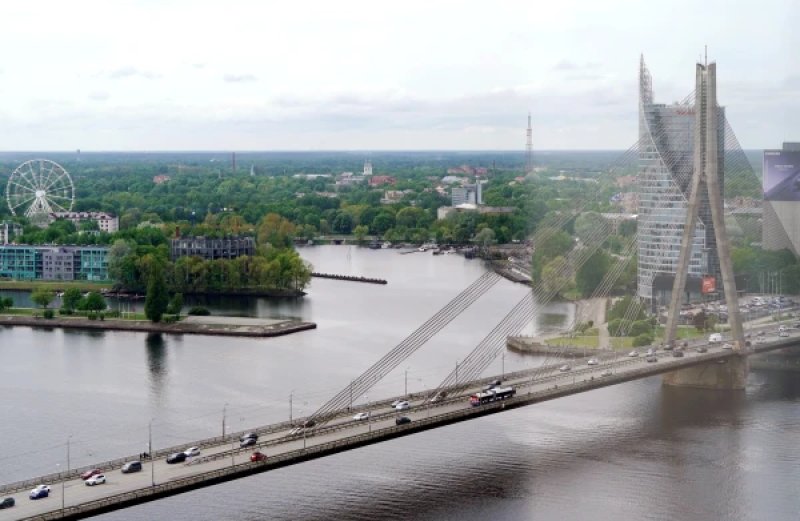
On Monday, August 17, the City Development Committee of the Riga City Council will consider the issue of creating a coordination commission that will address the consequences of the reconstruction of the Cable-Stayed Bridge. The initiative for the proposal came from the committee chairman, Edgars Bergolcs. In his opinion, preparations for the repair of one of the main bridges in the capital must begin in advance, as traffic restrictions will inevitably affect the transport situation, the operation of businesses, and the daily lives of Riga residents. "When the repair of the country's main bridge begins, a crisis will start in the city," the politician previously stated, explaining the need for such a structure. The commission is planned to include one deputy from each faction of the Riga City Council. It will operate for as long as necessary to address the issues arising during the preparation and execution of the reconstruction. The main task of the commission will be to find practical solutions that will minimize inconveniences for residents. This includes not only organizing traffic but also ensuring access to educational, cultural, and social institutions, safety, the condition of public spaces, and urban infrastructure. Particular attention will be paid to various scenarios for restricting traffic on the bridge — both during its partial and complete closure to vehicles. This means that the city will proactively seek alternative routes and assess how to redistribute traffic flows to avoid serious congestion. At the same time, the commission will not be involved in the actual construction or technical solutions for the bridge reconstruction. Its task is to minimize the impact of the repairs on the city. Interestingly, deputies propose not to limit themselves to the development of public transport. One of the possible alternatives is also to evaluate the use of urban water routes for passenger transport. Another area of work will be supporting entrepreneurs who may lose some clients due to changes in traffic patterns. The commission will be able to propose various assistance measures — for example, property tax discounts or other compensation mechanisms. The reconstruction of the Cable-Stayed Bridge will be carried out by a consortium of companies "Vanšu tilts," which offered to complete the work for nearly 69.8 million euros excluding VAT. The project includes a complete replacement of the cables, new road surface, updating pedestrian and bicycle infrastructure, as well as other modernization works on the structure. Funding is spread over several years: in 2026, up to 6.7 million euros is planned for the project, in 2027 — up to 42 million euros, and in 2028 — another 35.76 million euros. The Cable-Stayed Bridge is one of the most important transport facilities in Riga, so its reconstruction will be one of the largest infrastructure projects in recent years. This is why the city authorities are already beginning to prepare for the changes that will affect thousands of drivers, passengers, and residents of the capital.
