

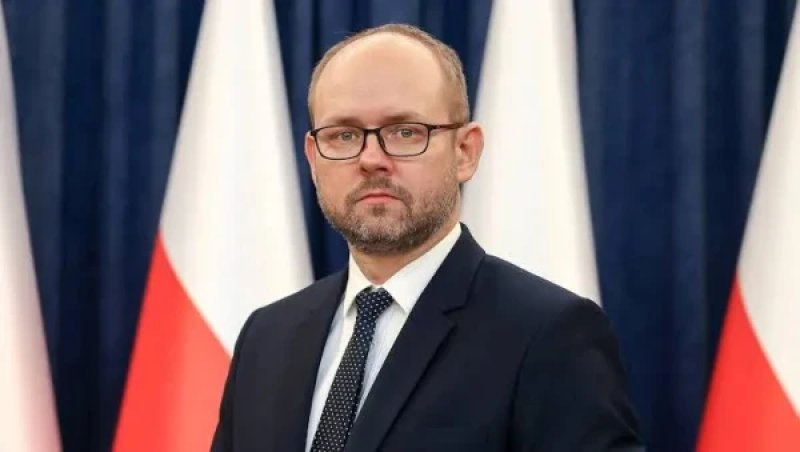
Poland warned Ukraine about possible consequences related to the intention to honor controversial nationalists in the planned memorial for heroes in Kyiv. The commemoration of such historical figures not only evokes regret from Poland's perspective but is also "short-sighted policy" from Ukraine's own standpoint, said Marcin Przydacz, advisor to the President of Poland Karol Nawrocki on foreign policy, on Monday. "A healthy form of nationalism is sometimes acceptable, but here we are talking about chauvinism, about an ideology close to Nazism," he said. Przydacz warned that the arising dispute could complicate Ukraine's integration into Euro-Atlantic structures. His statements came after Ukrainian President Volodymyr Zelensky signed a law on the establishment of the controversial National Memorial for Heroes. This topic has become another point of contention between Warsaw and Kyiv, whose relations have been strained for several months due to historical issues. The so-called Pantheon is planned to commemorate, among others, members of the Ukrainian Insurgent Army (UPA). While in Ukraine the UPA is honored for its role in the struggle for the country's independence, in Poland this organization is associated with the Volhynian Massacre — the mass extermination of the Polish civilian population. This topic remains one of the most painful in Polish-Ukrainian relations. The Volhynian Massacre, or Volhynian Tragedy, involved ethnic cleansing and the mass extermination of the Polish civilian population carried out by the UPA. Before World War II, Volhynia was divided between the USSR and Poland; however, after the war began, the Soviet Union occupied the Polish part of Volhynia. After this territory came under Nazi German occupation, on July 11, 1943, the Ukrainian nationalist partisan army UPA, which advocated for the creation of an independent Ukraine, began organized actions to exterminate the Polish population of Volhynia. It is estimated that by 1945 between 60,000 and 100,000 ethnic Poles were killed. As a result of retaliatory attacks and the subsequent partisan war in Volhynia, between 2,000 and 3,000 Ukrainians also died. As violence spread to other areas of eastern and southern Poland, where the then-communist regime began to carry out ethnic cleansing, another approximately 20,000 Ukrainians were killed by 1947. In June, Zelensky awarded one of the Ukrainian military units an honorary title related to the heroes of the UPA. The disagreements between Poland and Ukraine have further escalated after Polish President Nawrocki stripped Zelensky of the Order of the White Eagle — Poland's highest state award. In the context of the dispute, several Ukrainian and Polish politicians also refused awards. Thus, the historical dispute between Poland and Ukraine has taken a new turn. Warsaw makes it clear that the question of whom Kyiv officially considers national heroes could extend far beyond a discussion of history and affect contemporary political relations between Ukraine and Poland and its movement towards Euro-Atlantic structures.
