

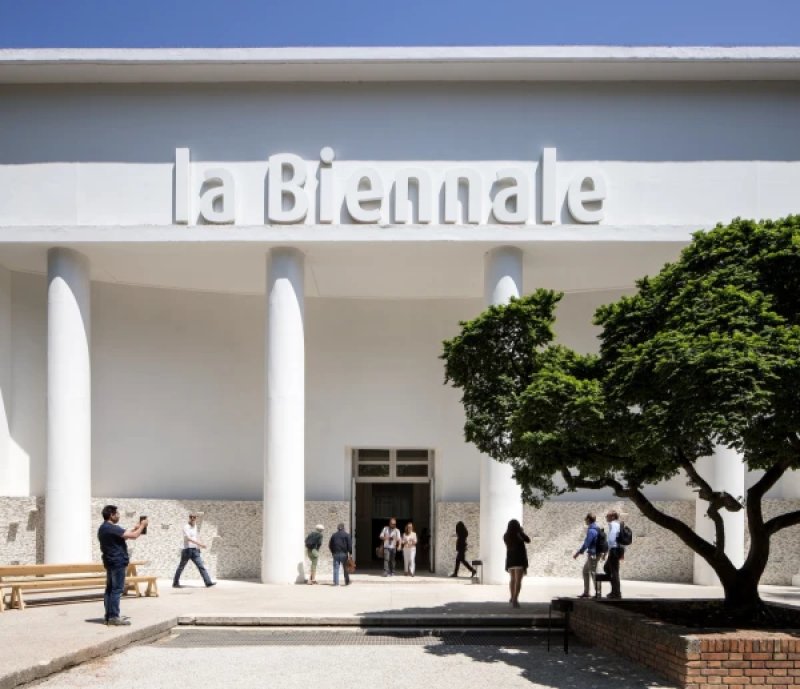
The Biennale 2026 has effectively marked a new turn in contemporary art: after several years of fascination with generative artificial intelligence, artists, gallery owners, and collectors are once again focusing on the materiality of the artwork, the imperfections of handcraft, and traditional techniques. The main exhibition In Minor Keys became the last curatorial project of Koyo Kuo. Its concept proposes to abandon visual noise and the aggressive digital environment in favor of a calmer and more personal interaction between the viewer and the artwork. The focus is on contemplation, empathy, memory, and the opportunity to pause in a world where a person constantly faces an enormous flow of information. Instead of spectacular digital installations, works that require time from both the author and the viewer are becoming increasingly prominent. At the same time, art market participants speak of a certain fatigue from images created by generative AI. The ability to obtain a technically flawless image in a matter of seconds gradually deprives that very flawlessness of its previous value. In contrast, signs of direct human involvement come to the forefront — irregularities, the texture of the material, traces of tools, and peculiarities of the execution technique. Everything that could have been perceived as imperfection not long ago is now becoming evidence of the uniqueness of the work. Particular interest is aroused by complex author graphics, ceramics, hand weaving, textiles, and analog photography. Along with them, the concept of "slow art" is being strengthened, which implies prolonged work on a piece and an equally unhurried acquaintance with it. Thus, technologicality itself ceases to be the main way to attract public attention. Artists are once again experimenting with physical materials, and viewers are invited not just to look at a striking object but to examine it, feel its texture, and trace the artist's work. However, the overall concept of the exhibition is controversial. Critics of "quiet art" argue that the desire for contemplation and a departure from visual aggression may appear as an attempt to distance oneself from the political conflicts and crises of the modern world. Proponents of the chosen approach, on the contrary, see it as a logical response to the information overload of recent years. In their opinion, art does not necessarily have to become another source of noise — it can create space for reflection, emotional recovery, and personal dialogue. As a result, the Venice Biennale 2026 demonstrates a noticeable shift in artistic priorities. After a period of rapid fascination with algorithms and generative technologies, the value of time spent by the artist, the mastery of hands, and the materiality of the work — that which cannot be reduced to an instantly created digital image — is once again gaining importance.
