

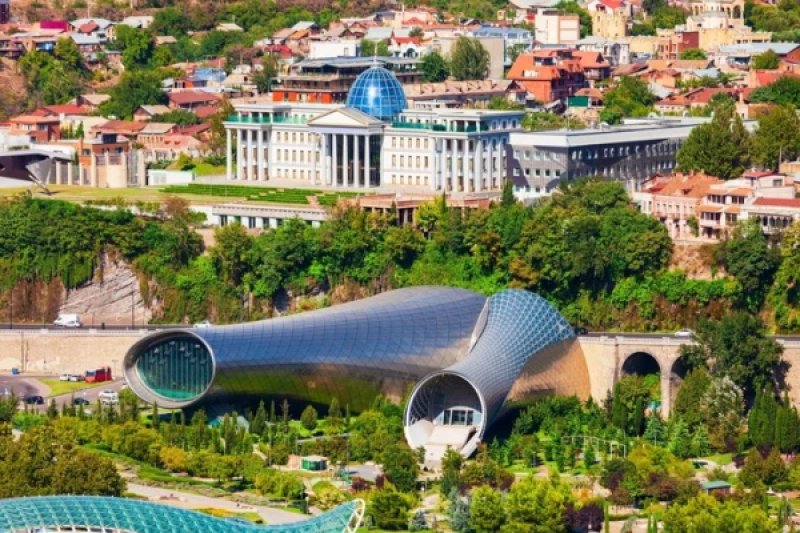
The building was constructed during the presidency of Mikheil Saakashvili and was meant to become one of the hallmarks of the renovated Tbilisi. However, the large-scale project never began full operation: for almost a decade and a half, the complex remained closed. Now it is being dismantled, [reports](https://www.bbc.com/russian/articles/c9356k4vlrpo) BBC. The area around the building is fenced off, and heavy machinery is at work. Workers are gradually removing the cladding, and the structure, which was recently clearly visible from the nearby Bridge of Peace, is literally disappearing from the cityscape before our eyes. ### A Symbol of Great Change The "Rike Jugs" were designed by the famous Italian architects Massimiliano and Doriana Fuksas. Inside, it was planned to house concert and exhibition halls. The project became part of a large-scale reconstruction of the Georgian capital that was carried out under Saakashvili. At that time, Tbilisi saw the emergence of many distinctly modern buildings made of glass and metal, sharply contrasting with the historical architecture of the city. One of the most famous structures of that era became the Bridge of Peace. Like other architectural projects from the Saakashvili period, it has repeatedly been the subject of criticism and controversy after the change of power. Some structures managed to survive the political changes almost unscathed. Others were repurposed. For example, the presidential residence built during Saakashvili's tenure was subsequently repurposed. The fate of the "jugs" was different. ### Built but Never Opened The complex was conceived as an important cultural venue for the country, but it failed to fulfill this function. For nearly 15 years, the expensive structure remained essentially unused. However, due to its unusual architecture, it became a notable part of Tbilisi's panorama and a well-recognized landmark among tourists. As a result, the building came to be perceived in two ways. For supporters of the architecture of the Saakashvili era, it was a symbol of the attempt to modernize Tbilisi and emphasize Georgia's European ambitions. For critics, it was an example of the costly and controversial projects of the former government. Now, the long-standing dispute over the future of the complex has been effectively resolved by construction machinery. ### Project Authors Learned of the Demolition Without Discussion The decision to demolish the building provoked a sharp reaction from the architectural firm Studio Fuksas, which developed the project. The architects stated that in over 60 years of professional activity, they had encountered a situation for the first time where one of their created buildings was being demolished without even inviting the authors to discuss possible options for its preservation. According to representatives of the firm, they had repeatedly expressed their willingness to cooperate, but neither government structures nor other interested parties initiated a dialogue with them. ### Architecture or Politics? The demolition of the "Rike Jugs" has reignited the debate about how Tbilisi should deal with the architectural heritage of the recent past. This is not just about a building that has been unused for many years. The complex emerged during a period of radical transformations in the country and is closely tied to the political era of Mikheil Saakashvili. That is why its fate has become part of a broader dispute: should controversial structures of the former government be preserved as part of the city's history, or does Tbilisi have the right to rid itself of projects that never found practical application? Thus, a building that was meant to become a symbol of a new Tbilisi has itself turned into a symbol of a controversial past. It was never fully utilized for its intended purpose, yet almost 15 years later, it has once again come into the spotlight — this time due to its disappearance.
