

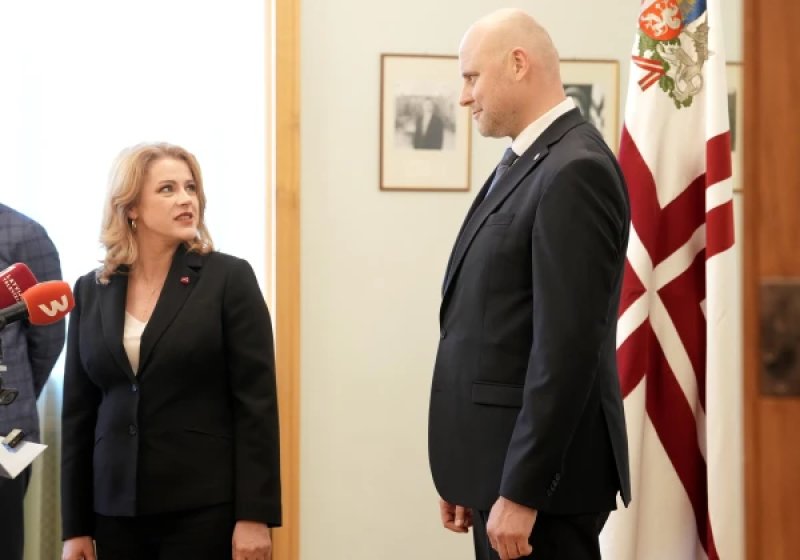
## "For airBaltic to Exist" Last week, former Prime Minister Silina commented on the saga with airBaltic: "Today, the Prime Minister says that there is finally a business plan. Yes, there is indeed a business plan, as during the last government we replaced the chairman of the board, appointed new chairmen of the council and the board, and I instructed to prepare a new business plan. Yes, the current government is lucky because the previous government created a good foundation for airBaltic to exist." Prime Minister Andris Kulbergs reacted immediately: "I don’t know whether to laugh or cry! Ms. Silina, you gave 340 million euros at 14.5% per year. In two years, the airline burned through that money, and not a penny is left! They also gave 30 million to keep the airline afloat for 2 months, and you call that a good plan? Two years ago, action needed to be taken. Nothing was done. The situation has reached a point where the state has practically lost control over the state-owned enterprise – there are no shares, no loans...". ## The Situation is Critical So, first, what is the situation with airBaltic? **First** – the situation is so critical that the Prime Minister and the government cannot even delay the decision until the elections. This means something needed to be done right now. **Second** – surprisingly, but true: having invested a total of 651 million (571 million before and during COVID, 50 million for bond purchases, and another 30 million as an emergency loan), the state has effectively lost control over its airline! Since the airline could not pay even the interest on the bonds in August, control over the airline has essentially been seized by creditors, namely the bondholders. Yes, among them is the state, which holds 13 percent of the bonds, but as you can understand, 13 percent is not enough to set the rules of the game. Paradox: 88 percent of the equity shares belong to the state, but de facto it owns nothing – there are no collateral, no fixed assets, no shares with real value. All that exists is the brand and flight routes. As far as can be understood, the planes are leased and not yet fully purchased. **Third** – at the beginning of the article, we already quoted the Prime Minister's words that the airline spent everything down to the last penny: both the 340 million euros received two years ago from the debt bonds and the 30 million loan provided in April of this year with the consent of the Saeima. To be fair, we note that part of this loan has been repaid by airBaltic. **Fourth** – to avoid bankruptcy or, to begin with, default, that is, the inability to fulfill financial obligations, the management of airBaltic persuaded the bondholders to agree to simply add the interest on the bonds to the principal amount of the debt (loan). In fact, the bondholders had no choice – otherwise, they could end up with nothing, as default would devalue the bonds. The total financial obligations of the airline, according to the opposition in the Saeima, have already reached 1.8 billion euros! ## Another 30 Million Down the Drain? In general, things are bad. But, as they say in Odessa, it can always get worse! And to prevent such a scenario – complete collapse – the government took an unprecedented step: a special law was developed – "On Measures for the Financial Stabilization of airBaltic." What does it provide? "To stabilize the finances of airBaltic, one or more of the following measures will be implemented in accordance with this Law: **1)** amend the agreement on the state loan of 30,000,000 euros granted to the company by extending the term for the repayment of the unpaid principal amount of the loan, accumulated interest, and other obligations arising from the agreement; **2)** fully or partially capitalize any claim arising from the state loan of 30,000,000 euros granted to the company; **3)** capitalize, convert, or otherwise transform claims arising from the state-owned bonds of the company in an amount not exceeding the actual unpaid principal amount of the state-owned bonds, but not more than 50,000,000 euros. **4)** participate in securing interim financing for the company by acquiring subordinated bonds of the company by the state in an amount not exceeding 30,000,000 euros." Notably, even before the law was passed, there was a promise that the repayment term for the 30 million loan would be extended to December 31, 2026. However, this date is not mentioned in the adopted law – it simply suggests extending it, and that’s it! Let’s be realistic: airBaltic will not repay the remaining part of the loan with interest, just as it will not repay the next 30 million, which will be provided to the airline solely for the purpose of keeping it afloat until the elections, that is, until October 3. As you can understand, Prime Minister Kulbergs would least like the airline to stop flying before the elections. And what about after the elections? ## It Won’t Take Off Without an Investor Since it is unlikely that the authorities will even risk allocating 600-700 million euros after the elections to maintain the controlling stake in airBaltic for the state, there is only one option left – to find a strategic investor. This is what the business plan provides, which, at the Prime Minister's request, was prepared by the management of airBaltic and the engaged consultants even before the special law was adopted. The plan states that by the end of the year, financing of 225 million needs to be attracted, and 100 million should be invested in equity capital. One cannot rule out the situation where... the state, that is, taxpayers, will once again have to "save the airline one last time." In any case, the stabilization law has been adopted. Instead of the "green peasants" who have refused, the currently opposition "progressives" supported the law. Their decision seems completely logical: for almost three years, the "progressives" were responsible for the Ministry of Communications and, therefore, for airBaltic as well. Therefore, now to refuse to extend a helping hand to the airline means risking being accused of almost deliberately driving the airline to bankruptcy. However, in any case, there is still a chance that airBaltic will become insolvent today. "Without a strategic investor, airBaltic will not be able to fly!" warned the company’s manager. Who would doubt it! The only thing left is to find that investor. And it would also be nice to know – will anyone be held accountable for bringing the airline to the brink of insolvency and for the loss of actual control by the state over the airline.
