

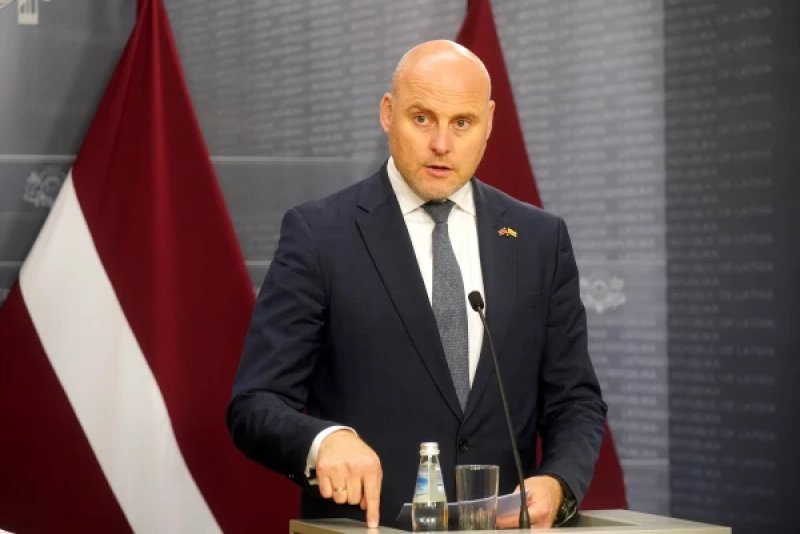
The level of military threat to Latvia has not changed, and the risk of direct military invasion of the country currently remains low, emphasized Prime Minister Andris Kulbergs (New Unity) in his message on Twitter. According to him, residents of Latvia have no reason to be concerned at this time. The low risk of direct military invasion is confirmed by information available to Latvian security services, and this was also publicly stated by the President of Latvia. At the same time, the Prime Minister emphasized that we live in times when a war continues nearby, with Russia against Ukraine. "We must be prepared for cyberattacks, attempts at sabotage, provocations, drones, and other manifestations of hybrid warfare," said Kulbergs, adding that this is why state services are operating at an increased level of alert, the eastern border is being strengthened, and the situation is constantly monitored in cooperation with NATO allies. > "However, readiness for a possible threat is not the same as an immediate threat. These two things should not be confused," emphasized Kulbergs. A draft order titled "On the Declaration of a State of Emergency in the Eastern Border Area of Latvia" was published on the legal acts portal, prepared by the Ministry of Climate and Energy (KEM). The draft order stated: "Considering the threats of escalation of military actions by Russia and the need to prevent a possible threat to the airspace for the operation of the healthcare, energy supply, and water management sectors of Latvia, (...) declare a state of emergency in the healthcare, energy supply, and water management sectors in the eastern border area of Latvia from the date of entry into force of this order until December 1, 2026." On Thursday, KEM clarified that the draft order does not provide for the declaration of a state of emergency but defines the procedure for actions in the event of its declaration. The Minister of Climate and Energy also clarified that there is currently no information about a planned invasion. According to him, the state must be prepared for various scenarios of aerial threats and establish a clear procedure for actions in such circumstances in advance. In turn, the Prime Minister noted in his statement that "in recent days, unfortunately, loud statements about the threats of escalation of military actions by Russia and the declaration of a state of emergency have been heard in the public space." Kulbergs acknowledged that such phrases, taken out of context of the actual assessment of the security situation, understandably raise questions and concerns among people. > "I urge both ministries and politicians to be particularly responsible in this matter. Security is not a tool for election rhetoric. One cannot gain political points from people's fears," the Prime Minister addressed his colleagues. He also explained that if any ministry needs special legal regulation to ensure the uninterrupted operation of hospitals, energy supply systems, water management, or other critical infrastructure in the event of a threat, the government will consider such proposals and make the necessary decisions. "This is our duty," stated the Prime Minister. > "But technical and organizational measures to ensure the state's readiness should not be presented to the public as if Latvia is on the brink of war," Kulbergs urged. He emphasized that Latvia is a safe country and a member of NATO. Allied forces are present here, Latvia's airspace is constantly monitored, the eastern border is being strengthened, and security services are working together with allies, Kulbergs listed. At the same time, he acknowledged that the government's task is to be prepared for the most unfavorable scenarios. "That is why we are strengthening the resilience of the state and critical infrastructure," stated Kulbergs. The Prime Minister urged the residents of Latvia to continue living their ordinary daily lives, to remain calm, but at the same time to stay vigilant. He called on politicians and public officials to be responsible with their words and not to create the impression of an immediate military threat where it concerns the state's preparation for possible crisis scenarios.
