

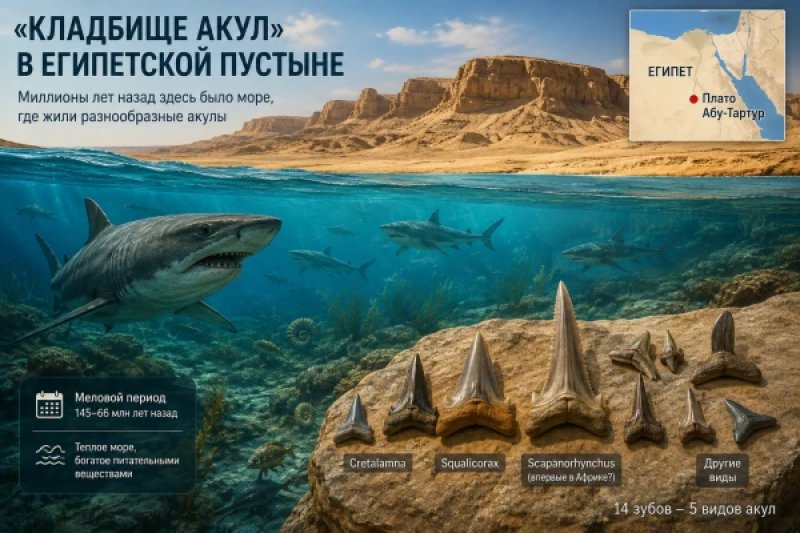
During the Cretaceous period, which lasted from about 145 to 66 million years ago, a significant part of North Africa looked very different. The territories that today are occupied by the Sahara were partially covered by a warm sea resembling modern tropical waters. It was rich in nutrients. Cold waters rising from the depths brought substances necessary for the development of plankton. Small marine animals and fish fed on it, which in turn became prey for larger predators. Among the inhabitants of this ancient sea were sharks. ## Seven Species in the Place of Today’s Desert The traces of the vanished ecosystem were discovered by paleontologists on the Abu Tartur plateau in Egypt. Shark teeth have been preserved in the phosphate deposits of the Duwi formation. Previously, scientists had already found remains of two species of sharks here. New research has identified five more. Thus, researchers now know of at least **seven species of sharks** that inhabited this region in the distant past. Among the discovered representatives of the ancient marine fauna are Cretalamna, Squalicorax, and Scapanorhynchus, as well as other long-extinct species. In total, during the new study, specialists examined 14 teeth and identified five species from them. ## The Most Unusual Find Particular attention was drawn to **Scapanorhynchus** — an ancient shark with characteristic long needle-like teeth. The find may be the first evidence of the presence of representatives of this genus in Africa. Moreover, the Egyptian specimen may belong to the latest known representatives of Scapanorhynchus. The differences in the shape of the found teeth suggest that ancient sharks occupied different ecological niches. Some may have hunted in relatively shallow coastal waters, while others preferred deeper shelf areas. Such diversity indicates the existence of a complex marine ecosystem here. ## Why There Were So Many Predators in the Ancient Sea One explanation for the richness of the local fauna is upwelling — a process in which cold water from the depths of the ocean rises to the surface, bringing a large amount of nutrients. This creates a kind of natural conveyor. Nutrients promote the reproduction of plankton, which is fed on by small organisms and fish, and they become food for larger animals. At the top of this food chain were sharks and other marine predators, including large marine reptiles. ## But There Was No Real 'Shark Cemetery' Here Scientists point out an important detail. The large number of found teeth does not mean that dozens of sharks died here at the same time. The phosphate deposits of the Duwi formation formed slowly, so remains accumulated over a long period. Consequently, the identified species may have inhabited these waters at different times. Nevertheless, the discovery provides paleontologists with valuable information about how diverse marine life was in North Africa during the Cretaceous period. Similar fossil finds have also been made in Morocco and Syria. Together, they allow for a completely different picture of this region: where today there are scorching sands and rocky desert, tens of millions of years ago, a warm sea stretched, in which numerous sharks and giant marine reptiles hunted.
