

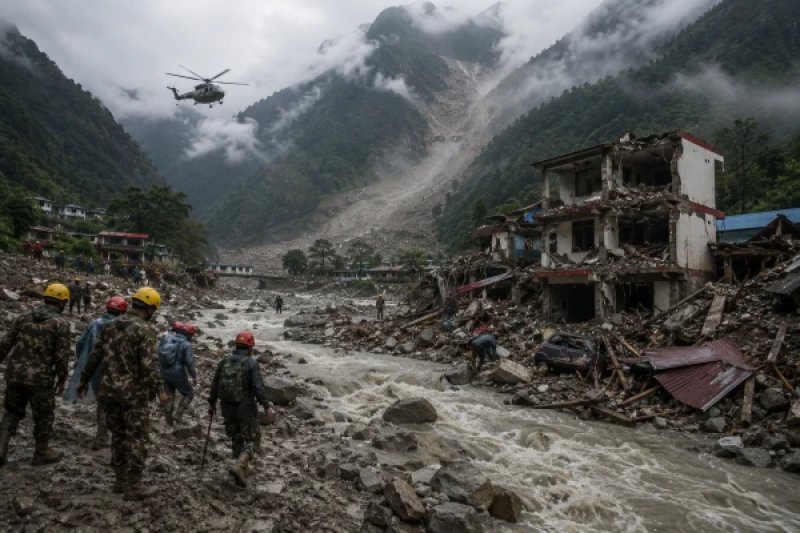
The list of these 33 individuals has been submitted by the Latvian Ministry of Foreign Affairs to the Ministry of Foreign Affairs of Nepal. The information has also been sent to the European External Action Service and the Ministry of Foreign Affairs of Finland, as Finland has an embassy in Nepal. The Latvian embassy in China has also forwarded the list to the relevant authorities. **There is virtually no communication with the affected area** A large-scale rescue operation is ongoing in the region; however, telephone communication and the internet remain unavailable, the Ministry of Foreign Affairs notes. Since the morning of August 28, the Nepalese police have also launched a public internet portal intended to assist families in identifying individuals. Lists of missing and found persons are posted there. However, a significant portion of the information is published in the local language and using local script. Some photographs are of low quality, and the individuals depicted have sustained severe injuries, further complicating identification. **One citizen of Latvia has been found safe** At the same time, the Ministry of Foreign Affairs has received information about one citizen of Latvia from another tourist group — he is safe in Tibet. The ministry acknowledges that there may be other citizens of Latvia in the region traveling with other groups or independently. Earlier this week, the Ministry of Foreign Affairs reported that based on information received from various sources, including relatives and friends of travelers, details about 39 tourists from Latvia who were in Nepal had been gathered. Of these, 34 citizens of Latvia were part of two tourist groups. According to the Ministry of Foreign Affairs, the search is complicated by the fact that none of the participants in these tourist groups registered in the Consular Register. Only one independent traveler was registered. Contact was made with him, and he is safe. It should be noted that on August 26, a glacier collapse triggered a powerful flow of ice, followed by a surge of water and mud from a glacial lake. The natural disaster caused widespread destruction in Nepal and China. According to the latest data, at least 630 people have died as a result of the disaster, and about 3,000 are reported missing. A large group of tourists from Latvia was also near the epicenter of the disaster.
