

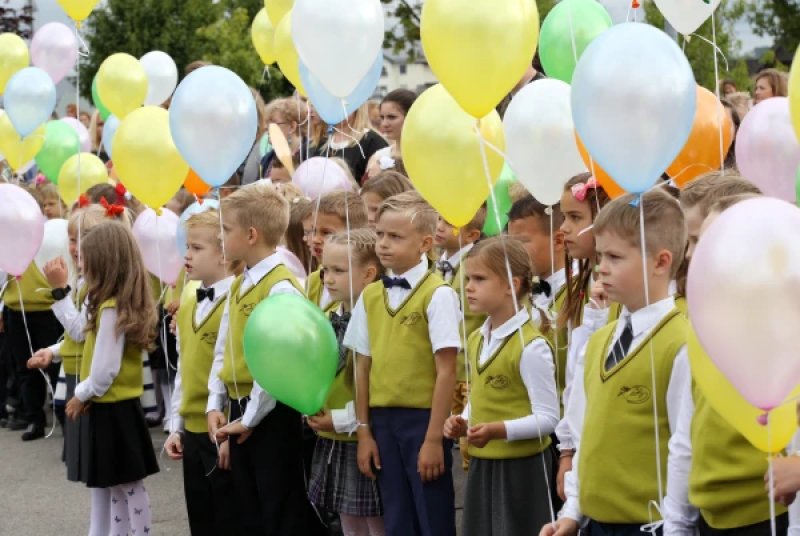
They will affect exams and assessment, the study of foreign languages, the use of mobile phones, distance learning, teacher salaries, support for children with special needs, as well as the procedure for issuing education documents. One of the innovations concerns ninth graders: at the end of the school year, they will have a state assessment test in natural sciences. This will replace the previous interdisciplinary work, which included social-civic, natural-science, and technological areas. Meanwhile, the question of the minimum threshold for passing centralized exams in the 9th grade has not yet been finally resolved: the current regulations provide for a threshold of 20% starting September 1, but the Ministry of Education proposes to abandon it. The issue is still planned to be discussed at the upcoming government meeting. Starting September 1, the next stage of the gradual abandonment of the Russian language as a second foreign language will be completed. All fifth graders and secondary school students must be given the opportunity to study at least two foreign languages: one — an official EU language, and the second — another official EU language or European Economic Area language or a language provided for by intergovernmental agreements. Those who have already started studying the Russian language will be able to continue it until the completion of the relevant educational program. The ban on the use of mobile phones in schools is also expanding. If previously it applied to preschoolers and students up to 6th grade, in the new school year it will be in effect up to and including 9th grade. An exception is possible if the teacher has allowed the use of the phone in the educational process. Clearer rules for blended learning are being introduced. In kindergartens, 1st and 2nd grades, distance learning will only be allowed in case of threats, emergencies, or other unforeseen situations. Starting from 3rd grade, distance learning is permitted in a limited volume: up to 5% of study time in 3rd grade, up to 10% in 4th to 6th grades, up to 15% in 7th to 9th grades, and up to 20% in secondary school. From the new school year, a new model for financing teachers' salaries, "Programma skolā," will be applied more widely. State funding will be directly linked, in particular, to the number of students in specific class groups. If a school does not meet the established quantitative criteria, part of the expenses for teachers' salaries will have to be borne by the founder (for example, the municipality). Exceptions are provided for certain schools. Support for students with special educational needs will change. Necessary information about specialists' conclusions and support measures will be taken into account in the State Information System of Education VIIS. Parents will not have to regularly resubmit the same documents. An individual educational plan must be developed within 21 calendar days after receiving the relevant conclusion. Schools are also required to develop continuity plans in case of threats or emergencies. In addition, educational institutions are mandated to systematically engage in violence prevention and ensure student well-being. There are also changes in the school nutrition program "Milk and Fruits for School." In addition to fresh fruits, vegetables, and milk, children will be able to be offered kefir and natural yogurt for free, and for students in grades 1-9, a honey tasting may be held once a school year. Another innovation: now, only one program of general or vocational education can be pursued simultaneously with state budget funding. Those who have already started studying several state-funded programs will be able to complete them under the previous conditions. Starting September 1, all state-recognized documents on general education will be issued and provided only in electronic form. If necessary, a paper copy can be obtained as a derivative of the electronic document. Changes will also affect higher education. Starting in 2027, all state universities and colleges will begin to implement an institutional funding model. Universities will gain more freedom in determining the number of study places, and the state order is planned to be more closely aligned with labor market needs, primarily in the fields of education, healthcare, and STEM. A new system of academic and research careers is also being gradually implemented.
