

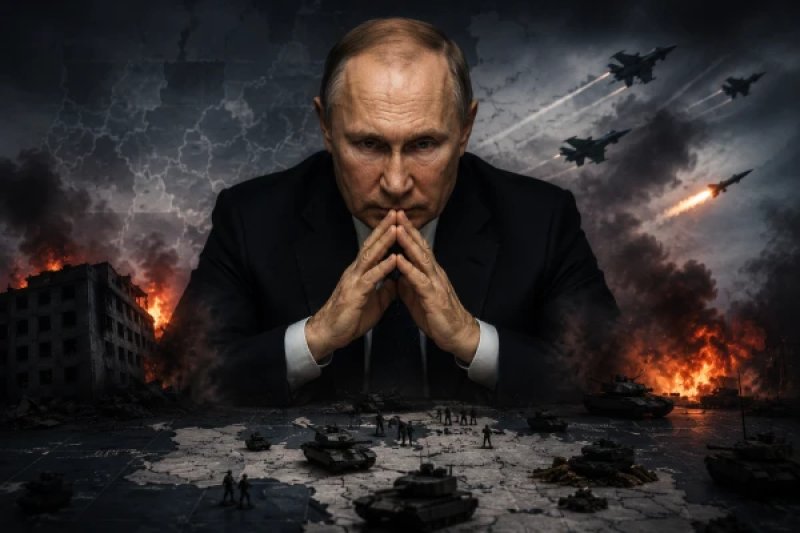
Vladimir Putin has decided to escalate the situation in the war with Ukraine, reports The Economist, citing sources close to the Kremlin. One of Putin's long-time associates suggested in a conversation with the magazine that the Russian leader perceived last week's visit to Moscow by CIA Director John Ratcliffe as a sign of weakness of the United States. According to the source, Putin interpreted the visit of Ratcliffe's predecessor, William Burns, who came to Moscow in November 2021, in a similar way. On August 22, Putin stated that Ukraine's attacks had opened a "Pandora's box" and promised retaliatory strikes on the most sensitive sectors of the Ukrainian economy. "No one can know what is going on in Mr. Putin's mind. However, the reasons for the escalation of the war, like the decision to invade, are internal in nature. His main goal has always been to maintain his own power and, ultimately, his own life," the article in The Economist states. The magazine notes that pessimistic sentiments prevail among representatives of the Russian elite. "As one source notes, the main problem lies not so much in the economy or the lack of military successes, but in the time that has been wasted on the war," The Economist writes. At the same time, the authors of the article clarify that none of Russia's economic or political problems pose a mortal threat to Putin by themselves. "The Russian system tolerates violence but does not forgive failure. Perhaps he [Putin] believes that ending the war without achieving at least a minimal goal—capturing all of Donbas in eastern Ukraine—would expose him to physical risk," the authors of the publication speculate. The Economist also claims that at some point, Putin allegedly told his associates that he would be hanged. Thus, The Economist links the possible further escalation not only to the situation on the front but also to the domestic political calculations of the Russian leadership. At the same time, the magazine's conclusions are largely based on assessments from unnamed sources, and the assumptions they present about Putin's motives cannot be independently verified.
