

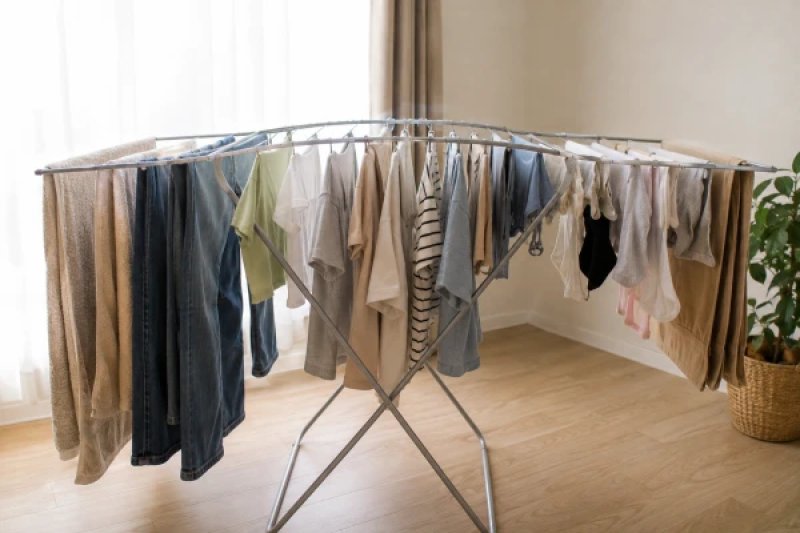
You can speed up the process without a dryer and additional heating. There is a simple way to hang clothes, known as the Japanese method of "arc drying." It is easy to apply on a regular home drying rack. ## What the Japanese Method Involves The essence of the method is that the longest items are placed at the edges of the drying rack, while shorter items are hung closer to the center. For example, large towels, pants, or long items can be hung on the outer sides, followed by T-shirts and shirts, and closer to the middle, you can place underwear, socks, and other small clothing items. If you look at the lower edge of the laundry hung this way, it will resemble an arc: the items at the edges hang lower, while those in the middle are higher. Hence the name of the method — "arc drying." ## Why Laundry Can Dry Faster The main task in natural drying is to ensure good air circulation between wet items. If a large number of clothes of approximately the same length are hung tightly, the airflow between the fabrics is hindered, and the evaporated moisture is trapped near the laundry. By placing items in an "arc" shape, more free space remains under the central part of the drying rack. Air can circulate more easily between the items, which can speed up moisture evaporation. It is also important not to press wet clothes against each other. Gaps should be left between items: the freer the air moves around the fabric, the more effective the natural drying process. ## How to Properly Hang Clothes After washing, shake each item well and smooth out the wrinkles. This not only makes subsequent ironing easier but also allows the fabric to come into better contact with the air. Start with the longest items. Place towels, pants, and large clothing items on the outer edges of the drying rack. Hang medium-length items closer to the center, and leave the shortest ones in the middle. Do not try to fit as much laundry as possible on a small drying rack. If items touch each other, hang tightly, or overlap neighboring items, air circulation worsens, and the advantage of the method is largely lost. ## How to Dry Jeans and Pants Faster Thick pants and jeans often remain damp in the waistband, seams, and pockets even when the legs are almost dry. To speed up drying, it is better not to fold pants in half on the bar. They can be secured by the waistband in several places so that there is free space inside. This allows air to circulate not only around the item but also inside it. It is advisable to turn pockets inside out if the model allows. This way, the thick multilayer areas of fabric can dry faster. ## Where to Best Place the Drying Rack Even the correct arrangement of items will do little good if the drying rack is in a damp corner with virtually no air movement. The drying speed is primarily influenced by temperature, humidity, and air circulation. Therefore, it is best to place the drying rack where air can move freely around it. If there is a fan at home, it can be positioned so that the airflow passes through the hung laundry. Constant air movement helps to carry away the moisture-saturated air from the surface of the fabric and speeds up evaporation. A dehumidifier may also be useful in a humid room. However, it is not advisable to close a large number of wet items in a small, unventilated room: the humidity will quickly rise, causing the laundry to take longer to dry. Additionally, constant high humidity in the room can contribute to condensation and mold growth. ## Does the Japanese Method Really Work? The principle of this method is quite explainable: the better the air circulates around the wet fabric, the faster water evaporates under otherwise equal conditions. However, it is impossible to specify a universal time that can be saved by "arc drying." The result depends on the temperature and humidity in the room, ventilation, the amount of laundry, the density and composition of the fabric, as well as how freely the items are hung. Therefore, "arc drying" will not replace a dryer, but it can help reduce the time for natural drying of laundry without additional heating. The main thing is not to overload the drying rack, leave space between items, and ensure air movement in the room.
