

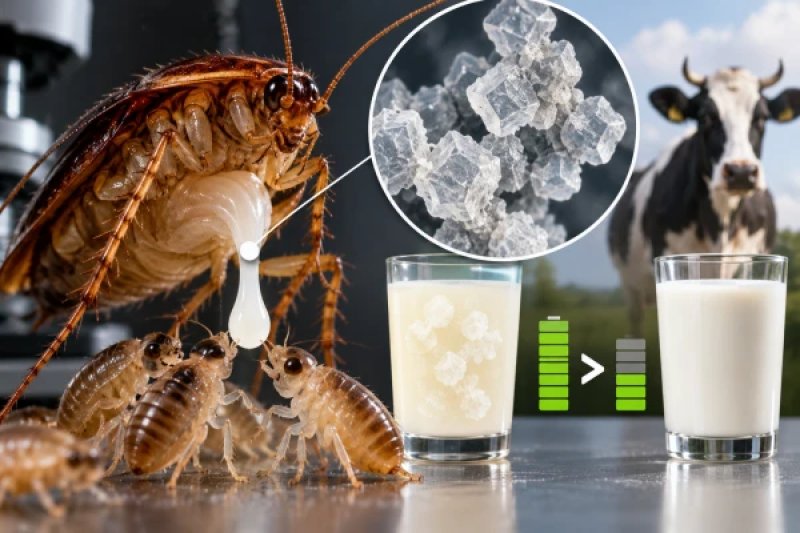
**Biomechanics** One of the most unusual works was an attempt to understand what constitutes a kiss and where this behavior originated. Matilda Brindle, Catherine Talbot, and Stuart West received the award in the field of biomechanics for a more precise definition of a kiss and the study of its evolution. The scientists concluded that many primates kiss in one form or another. They also believed that Neanderthals were familiar with kissing, allowing for the possibility that Neanderthals may have kissed or may not have kissed Homo sapiens. **Chemistry** Equally unexpected is the work that won in the chemistry category: a group of researchers studied the “milk” of the viviparous cockroach Diploptera punctata. This species feeds developing embryos with a nutrient-rich liquid, which then transforms into protein crystals in the embryos' intestines. It turned out that such a crystal contains more than three times the energy of a comparable amount of cow's milk. The researchers were intrigued by the unusual structure of the substance and the cockroach's ability to store nutrients for its offspring. The challenge now is to find practical applications for cockroach milk in household use. **Soil Science** The largest experiment was conducted by soil scientists. In over 25 countries, volunteers buried about a thousand identical pairs of men's cotton underwear and then excavated them after 30 and 60 days. The task was not easy: assessing the activity of organisms in the soil based on the degree of decomposition of the fabric. The rate of tissue decomposition can serve as an indicator of biological processes. It turned out that the underwear decomposed fastest in private gardens, where the soil contained more organic matter. In lawns, the activity of soil organisms was lower, while in fields and meadows, the indicators were intermediate. Temperature and humidity, unexpectedly for the researchers, also affected the rate of decomposition. **Physics** Another award went to the authors of a development that could impact the lives of public restroom visitors. Randy Herd, Zhao Pan, Tadd Traskott, and Kavishan Turairaja developed a urinal designed to eliminate splashing. The scientists found that the angle at which the stream hits the surface is crucial. At an angle of about 30 degrees, splashing is significantly reduced. The created design was named “Nautilus.” **Technology** The technology award went to specialists who used the proboscises of dead female mosquitoes as ultra-thin nozzles for 3D printing. They named the technology “necrophillic printing.” The proboscis proved suitable due to its very small diameter and ability to direct the flow of liquid. The 3D necro-printer achieved a resolution of 18–22 microns—about half that of the smallest commercial metal tips. The scientists claim that in the future, this approach could be useful in creating microscopic electronic components and scaffolds for living cells. Or it may not. **What is the Prize** The Ig Nobel Prize has existed since 1991. It was conceived by Marc Abrahams, editor of the humorous scientific journal Annals of Improbable Research. The award serves as a parody of the Nobel Prize and is given for dubious achievements in various fields. The 2026 ceremony was special: for the first time in 35 years, it took place outside the United States—in Zurich, Switzerland. The organizers explained the change of location due to safety concerns for foreign participants. In 2027, the award ceremony will be held in Antwerp, Belgium, and in 2028, it will return to Zurich.
