

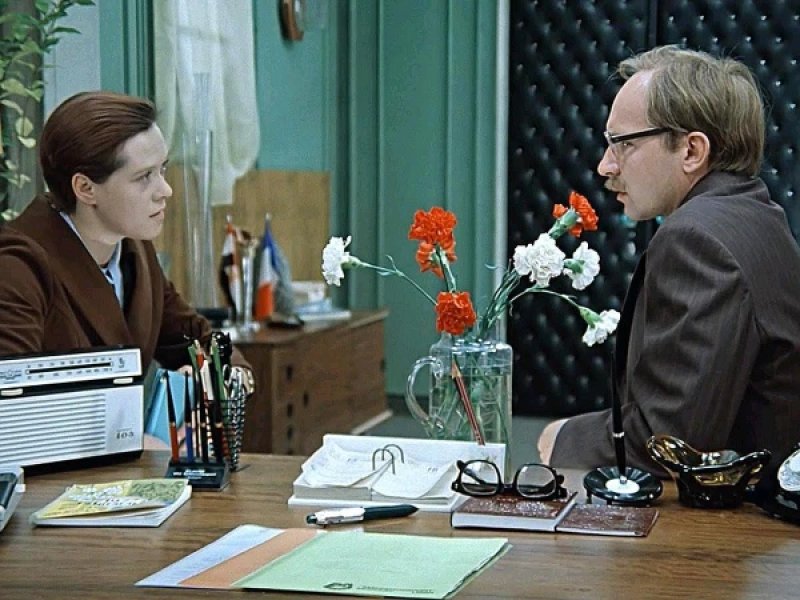
We publish an exclusive excerpt that includes the words "mymra", "prosak", "tsugunder", "karachki", and "tormashki". **Mymra** "We call her… 'our mymra'. Of course, behind her back" — this is how the character played by Andrei Myagkov described the head of the statistical institution, Lyudmila Prokofyevna, at the beginning of the film "Office Romance". But who is a "mymra"? The explanatory dictionary of Ozhegov provides the following definition: "A boring, gloomy, and uninteresting person." Moreover, it assures that this definition can equally apply to both men and women. In reality, however, a mymra is usually referred to as a female. Linguists believe that "mymra" has Komi-Permyak roots and derives from the word "mynira" — "gloomy". In Dahl's dictionary, there is a verb "mymrit'" meaning "to sit at home without going out". This is also generally an activity for gloomy people. "Mymra — the nose is torn out" — in the Black Earth region, this saying is recalled when one wants to say that a person has been undeservedly praised. Additionally, there is a river named Mymra in the Lyubimsky district of the Yaroslavl region. However, it is very small, with a length of only 16 km. In literature, by the way, "mymra" can also be found in Chekhov's short story "Eclipse of the Moon". Again, this word is used as an insult when one official insults another by calling him a "mymra". **Prosak** Everyone knows what the expression "to get into a prosak" means — to find oneself in a difficult situation. However, the word "prosak" itself is unclear. The thing is that "prosak" used to refer to a device for twisting ropes from individual threads. This meaning is still present in dictionaries today — although marked as obsolete. Ropes were twisted by rotating a special spinning wheel, and the threads were twisted in a particular way to create a rope. If, however, the edge of clothing or hair accidentally got caught in the device, it was impossible to free oneself, only to cut it off. So, to "get into a prosak" in the literal sense means to find oneself in a rather unpleasant situation. **Tormashki** How does one fly upside down? Where are a person's tormashki? It turns out that there are no tormashki at all. As Vladimir Dahl writes, this interesting word is derived from the verb "tormoshit'" — "to tug, pull, shake". Compare: to stand → stance, to shake → shake, to torment → tormashka. As for the word "tormoz" (brake), our "tormashki" apparently have no relation to it. Even though there is an obsolete word "tormas" in Russian, which referred to a metal strip under the runners of sleds that essentially served as a brake. It would be logical to assume that "upside down" refers to when the sleds are overturned — upside down. But no. The term "tormashki" is never used separately, but the expression "upside down" can even be found in works from a century and a half ago. "Here he will be put upside down, and no one will know anything, see anything, or hear anything!" — writes Saltykov-Shchedrin in "Letters from the Province". "Just to preface, whoever comes to my roof — I will send him down upside down!" — and this is from Turgenev's "The Steppe King Lear". By the way, in Dahl's dictionary, you can find several other interesting nouns derived from the verb "tormoshit'". "Tormoshitel'" — one who torments someone or something. "Tormoshnik" — a little rope or handle that is pulled when something needs to be shaken, that is, to be tormoshit'. **Tsugunder** "Taverns and women will lead you to tsugunder," — said the criminal authority Gorbatiy in the film "The Meeting Place Cannot Be Changed". In principle, from the context of the phrase, one can already guess that "tsugunder" is something unpleasant, something that a good person would not wish for. In fact, the word "tsugunder" has two main but similar meanings. Firstly, "tsugunder" refers to a prison, hard labor, guardhouse, or some place of detention. Secondly, it is used in a broader sense to refer to any punishment, primarily, of course, corporal punishment. For this reason, you can encounter the use of this word with different prepositions. For example, the expression "to take to tsugunder" can mean "to whip" or to punish. "To lead to tsugunder" means "to lead to prison". To be fair, in literature or colloquial speech, one can find the formulation "to take for tsugunder" — to grab the guilty for punishment. An analogous phrase is "to take by the throat". Now let's examine the origin of the word. It entered everyday speech from military slang around the mid-19th century. "If there is even one more scandal in your noble house, I will send you to tsugunder, as they say in high style," — is found in Dostoevsky's "Crime and Punishment". Most researchers believe that the roots of "tsugunder" are German. However, it is unclear from which specific expression this word originated, and opinions vary. Either a guilty soldier was sentenced to a hundred strokes with sticks: zu hundert — "to a hundred". Or it refers again to the German zu Hunden — "to the dogs". **Karachki** Interestingly, in Ushakov's explanatory dictionary, there is a strange variant of the spelling with the letter "o" — "koarachki". But if we look into the history of the word, this unusual form seems more logical. However, let's proceed in order. What are "karachki"? This is a position where a person supports themselves on their palms and knees at the same time. In simpler terms, they are on all fours. Here it is appropriate to recall the verb "raskoryachit'sya". Both of these words — "karachki" and "raskoryachit'sya" — trace back to the Old Russian "korka" — leg (not to be confused with "korki", which means shoulders). The word "korka" has now disappeared from the language, but there are plenty of words in which its presence can be noticed. This includes, for example, "okorok", which literally translates to "that which surrounds the leg". One could also mention "kortochki": it seems reasonable to assume that this word is also derived from "korka". Thus, "to sit on kortochki" means "to sit on little legs". However, this is not the case. Linguists lean towards the idea that the adjective "korotkiy" (short) is closer to "kortochki". In Slavic languages, including Russian, many words are formed from the root *kortъ, which means "short", "cut off". This includes both "kurtka" (jacket) and "kurnosy" (snub-nosed), and "obkornat'" (to trim). That is why "to sit on kortochki" could literally be translated as "to sit on short legs".
