

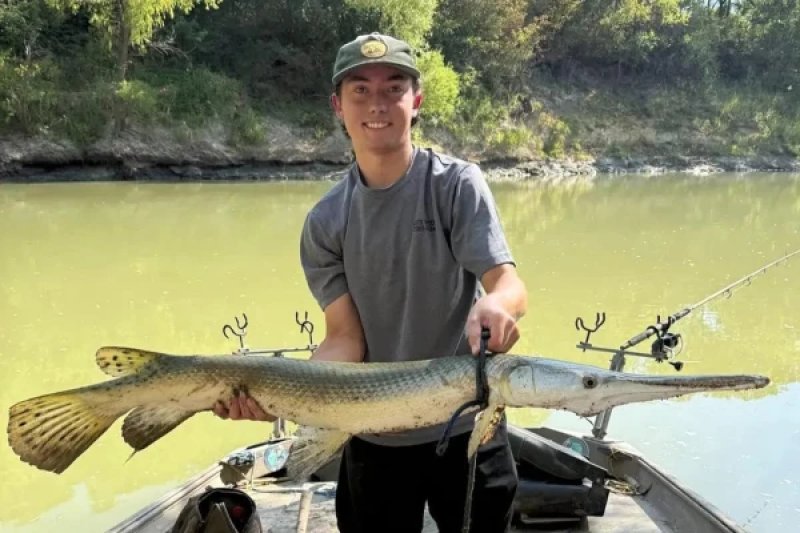
According to the American website Chron, citing the Texas Parks and Wildlife Department, a local resident, Sebastian Benitez, recently caught a rare hybrid of two species of armored catfish while fishing in the Trinity River — a female alligator gar and a male long-nosed armored catfish. The fish looks as if nature combined features of both species. Alligator gars have short, wide snouts resembling those of crocodiles, while long-nosed armored catfish have extremely long and narrow snouts, like needles. Their hybrid has an elongated and triangular profile. There are four species of armored catfish in Texas: spotted, short-nosed, long-nosed, and alligator. They can rightly be called "living fossils" as they belong to a very ancient lineage of fish that existed long before the appearance of humans or even dinosaurs on the planet. **What Makes Armored Catfish Interesting** Armored catfish have existed for over 200 million years, diverging into separate species about 100 million years ago. A study conducted in 2024 first revealed the biological mechanism that explains why some animals seem to have frozen in time. It was found that for some "living fossils," evolution occurs significantly slower, meaning they can create viable hybrids with other species — even if they have not shared a common ancestor since the time of the dinosaurs. The hybrid of alligator gar and long-nosed armored catfish is unique in that the divergence of its parent species is the oldest among animals, plants, and fungi. Such hybrids are rare. According to the Texas Parks and Wildlife Department, they make up only about one to two percent of the catfish population. Nevertheless, in 2024, another hybrid of alligator gar and long-nosed armored catfish was caught in the Trinity River. **How Armored Catfish Can Help Humans** In addition to surviving virtually unchanged for millions of years, armored catfish have other remarkable properties. Scientists have established that these fish have the lowest known level of genetic mutations among jawed vertebrates, which researchers believe is linked to an extraordinarily efficient DNA repair system. The most intriguing aspect is that if researchers can understand these processes, it may aid in the search for methods to combat cancer in humans. The researchers' idea is to understand which mechanisms allow armored catfish to quickly detect and correct DNA damage. In human cells, disruptions in DNA repair systems lead to the accumulation of mutations and genetic instability, which can contribute to tumor development. Therefore, studying the natural mechanisms of genome protection in such fish could potentially suggest new ways to prevent the accumulation of harmful mutations or enhance repair systems in human cells.
