

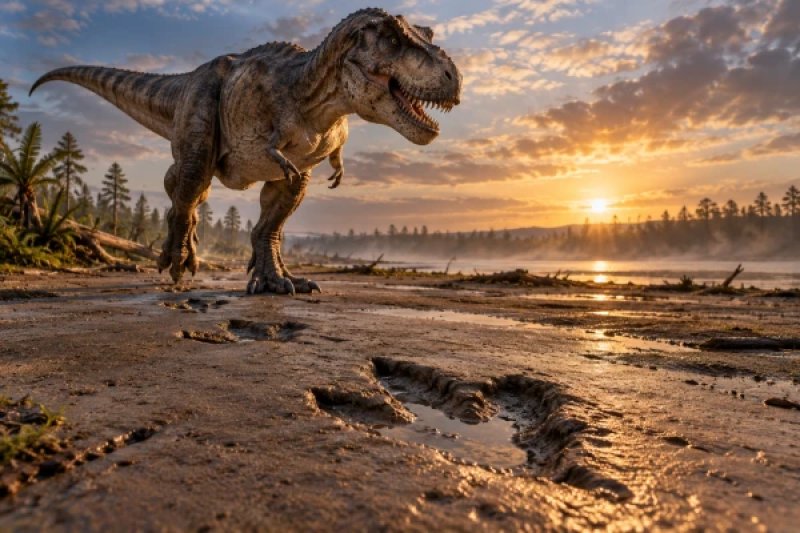
The track, measuring about 7 meters, includes 4 three-toed footprints. They were found in southwestern North Dakota. Each footprint measures approximately 0.9 meters. The age of the find is estimated at 66.5 million years. The attribution to Tyrannosaurus rex was determined by the unusually large size of the footprints and the narrow shape of the toes. Additionally, fossil remains of this species are frequently found in the area, which confirmed the paleontologists' conclusions. Until now, only individual tracks of adult specimens had been discovered, and the complete sequence of steps has been documented for the first time. Tyler Lyson, senior curator of vertebrate paleontology at the Denver Museum of Nature & Science, noted: "Bones tell us a lot about animals, but footprints convey behavior at a specific moment. They allow us to trace how the creature moved across the landscape." The footprints, found in 2025 on federal land near Marmarth, were documented using high-precision 3D scanning. Digital models give researchers the ability to study the tracks remotely and create physical copies for museums. Professor Peter Falkingham from Liverpool John Moores University led the analysis remotely: colleagues sent him 3D models straight from the field, and he examined them in virtual reality as thoroughly as on-site at the excavation. The analysis revealed that the dinosaur's step was about 4 meters. From this, researchers concluded that the animal moved at a speed of 3.5 to 4.5 miles per hour (approximately 5.6–7.2 km/h). This corresponds to a brisk human walk.
