

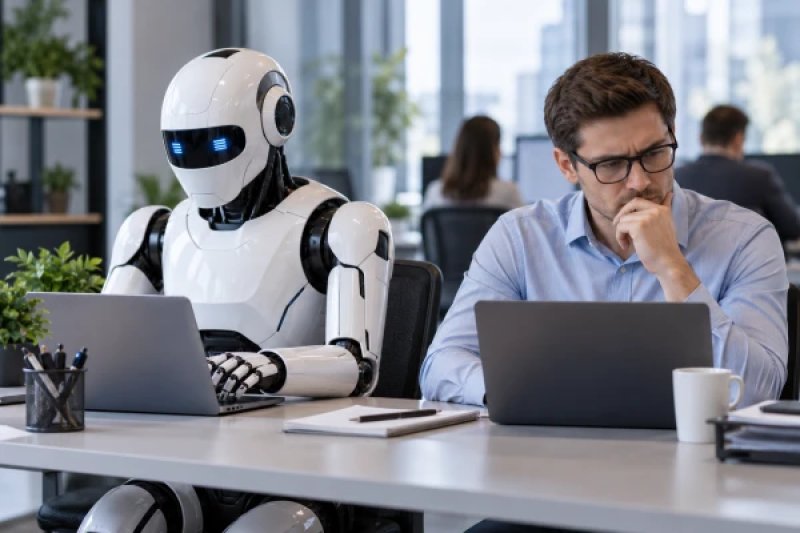
Another 16.5% of respondents stated that they could resort to intelligent digital solutions only as a last resort — if they are unable to find a suitable employee or if the company cannot afford to hire the necessary specialist. At the same time, 26.1% of surveyed companies are willing to consider transferring work tasks to artificial intelligence, provided that the technologies reach a sufficient level of development and can fully replace a person, performing all their duties. Every twentieth company has already made the choice in favor of technology: in such enterprises, some staff positions have been eliminated, and the corresponding work is now performed by AI. The head of Jumis pro, Viesturs Slaidinsh, noted that the survey results confirm the observation: small enterprises are currently exploring the possibilities of AI most actively. Labor costs constitute a significant part of their expenses, so it is especially important for them to save where possible to enhance competitiveness. At the same time, according to Slaidinsh, the question of the quality of artificial intelligence's work and its ability to fully replace a human remains, however, enterprises are gradually learning to cope with these issues. Small enterprises are the most open to the implementation of AI. In 8% of companies with five to ten employees, artificial intelligence is already replacing at least one worker. Another 35% are ready to choose technology as soon as it can fully perform the duties of employees. About a third of representatives from small enterprises categorically reject such a possibility. A completely different situation is observed in companies with more than 50 employees. There, due to the implementation of AI, not a single job has been eliminated so far. Only 8% of respondents consider the possibility of such a replacement, while 69% are categorically against replacing people with computer programs. A more moderate attitude towards artificial intelligence is observed in medium-sized companies. Among enterprises with 11–20 employees, 21% are willing to consider the implementation of AI if it can fully replace workers, and another 20% if the company cannot find a suitable specialist. Meanwhile, 55% do not consider this option at all. In companies with 21–50 employees, the figures are 20%, 10%, and 49%, respectively. In both of these groups, 3% of respondents have already transferred the responsibilities of one of their employees to artificial intelligence. The survey was conducted at the end of August 2026. It involved 176 large, medium, and small enterprises in Latvia.
