

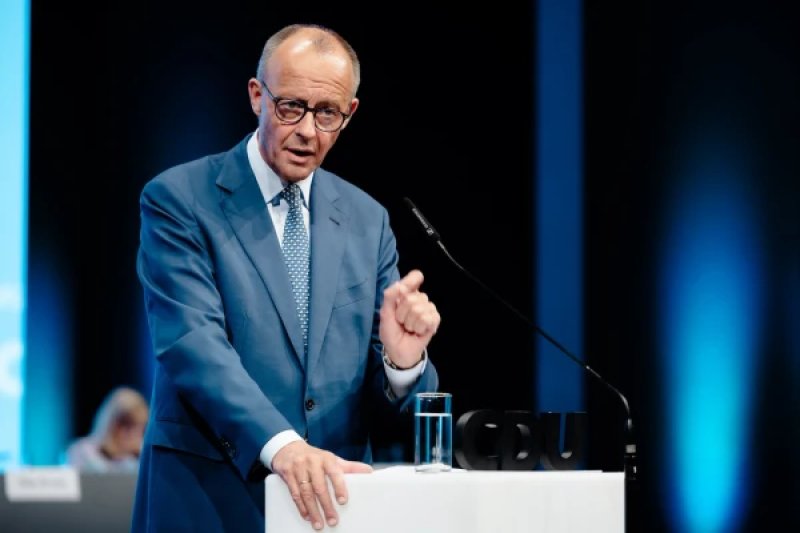
Only 14% of Germans believe that the current Federal Chancellor of Germany, Friedrich Merz, is the right person for the job. 78% of respondents are dissatisfied with the head of government, while another 8% did not respond, according to a survey conducted by the INSA opinion research institute on September 10 and 11. The results of the study were published on Saturday, September 12, on the tabloid Bild's website. Moreover, among voters of the ruling conservative bloc of the Christian Democratic Union, led by Merz, and the Christian Social Union (CDU/CSU), only 36% support the current chancellor. 58% of voters oppose him. Merz's popularity has been gradually declining for more than a year. In June 2025, about a month after the new chancellor's government began its work, he was supported by 36% of Germans, but by September 4, 2026, the support level had fallen to 16%. Currently, 31% of respondents believe that among the CDU/CSU representatives, Markus Söder, the head of the CSU, could be a more effective leader of the government than Merz, while another 20% would prefer Hendrik Wüst, the Prime Minister of North Rhine-Westphalia, and 13% would support Interior Minister Alexander Dobrindt. ## ## Germans are also dissatisfied with Vice Chancellor and Finance Minister Klingbeil Vice Chancellor and Finance Minister Lars Klingbeil, who heads the Social Democratic Party of Germany (SPD), has also faced dissatisfaction from Germans. 51% of respondents stated that he is not suitable for the position of party leader, while only 24% supported the politician. However, among SPD members, satisfaction with Klingbeil is significantly higher: 57% are satisfied with his work, while 30% would like to replace him. Respondents identified Boris Pistorius, the Minister of Defense, as the main candidate for the position. 34% of all respondents and 51% of party supporters would like to see him as the leader of the SPD. ## ## 46% of Germans oppose the “firewall” policy regarding the AfD A recent INSA survey also showed that nearly half of Germans (46%) oppose the “firewall” policy, which implies a refusal to cooperate with the far-right party Alternative for Germany (AfD). 34% of respondents supported maintaining the barrier, while another 20% found it difficult to respond. Regarding the ban on the AfD, opinions were almost evenly divided. 42% of respondents supported this idea, while 45% opposed it.
